


Page 16 - 02ed2018
P. 16
The additional double bond isn’t what we’re going to concern ourselves with, but rather the introduction of
               alkylation at the 17th carbon position (which puts Dianabol in the category of C-17 alpha alkylated
               steroids). When I look at methyltestosterone (the same structure without that bond), I see a more toxic,
               less effective anabolic. Therefore, I would imagine that the c1-2 bond doesn’t contribute significantly to a
               toxic effect, and may actually lessen it (speculation on my part).


               When you ingest Dianabol (or any C-17 alpha alkylated steroid), it travels to the intestines, is absorbed
               into portal circulation, then transported to the liver. The liver is the primary deactivator (and metabolizer)
               of androgens like testosterone. It functions as the body’s filtration system. If you were a steroid, and there
               was one place you’d want to avoid, it’s the liver. But this is exactly where most oral steroids end up.

               An exception to this rule is Andriol, which is testosterone with an undecanoate ester, an unusual oral
               steroid that makes use of a gel cap and avoids the liver through being absorbed into the lymphatic
               system. So it’s not liver toxic – but it’s not useful, either. Despite being testosterone, it’s both weak (users
               report mild gains at best), and expensive (a week’s worth could buy a two month supply of the injectable
               form). Still, it’s an improvement over just eating raw testosterone. An alternative way to deliver
               testosterone orally would obviously be to alkylate it at the 17th carbon position thereby creating the
               aforementioned methyltestosterone (and of course, another way to deliver testosterone would be to inject
               it, perhaps with 17 beta esterification and a propionate ester). Of note here is that it is not the
               testosterone itself that can potentially cause problems with the liver – because studies performed on
               injectable and topical testosterone do not show the same liver enzyme elevation as seen with
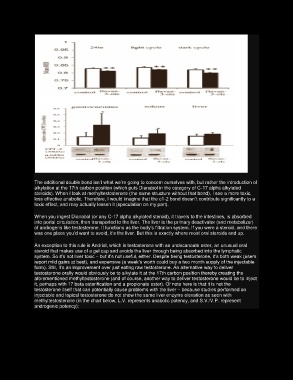
               methyltestosterone (in the chart below, L.V. represents anabolic potency, and S.V./V.P. represent
               androgenic potency):

