


Page 57 - Nilam_Publication_module_Chemistry_Form.pdf
P. 57
Chemistry Form 4 • MODULE

                        Example / Contoh:
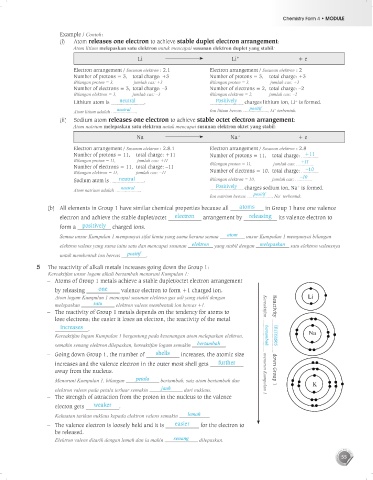
                        (i)   Atom releases one electron to achieve stable duplet electron arrangement:
                            Atom litium melepaskan satu elektron untuk mencapai susunan elektron duplet yang stabil:
                                                  Li                              Li +                   + e

                             Electron arrangement / Susunan elektron : 2.1               Electron arrangement / Susunan elektron : 2
                             Number of protons = 3,  total charge: +3      Number of protons = 3,  total charge: +3
                             Bilangan proton = 3,    jumlah cas: +3        Bilangan proton = 3,    jumlah cas: +3
                             Number of electrons = 3,  total charge: –3    Number of electrons = 2,  total charge: –2
                             Bilangan elektron = 3,   jumlah cas: –3       Bilangan elektron = 2,   jumlah cas: –2
                                                                                                        +
                             Lithium atom is   neutral  .                    Positively   charges lithium ion, Li  is formed.
                                           neutral                                      positif  +
                             Atom litium adalah   .                        Ion litium bercas   , Li  terbentuk.
                        (ii)  Sodium atom releases one electron to achieve stable octet electron arrangement:
                            Atom natrium melepaskan satu elektron untuk mencapai susunan elektron oktet yang stabil:
                                                  Na                              Na +                   + e
                             Electron arrangement / Susunan elektron : 2.8.1               Electron arrangement / Susunan elektron : 2.8
                             Number of protons = 11,  total charge: +11    Number of protons = 11,  total charge:   +11
                             Bilangan proton = 11,    jumlah cas: +11                                     +11
                             Number of electrons = 11,  total charge: –11  Bilangan proton = 11,    jumlah cas:   –10
                             Bilangan elektron = 11,   jumlah cas: –11     Number of electrons = 10,  total charge:
                             Sodium atom is   neutral  .                   Bilangan elektron = 10,   jumlah cas:   –10
                                             neutral                         Positively   charges sodium ion, Na  is formed.
                                                                                                         +
                             Atom natrium adalah   .
                                                                                                   +
                                                                           Ion natrium bercas   positif  , Na  terbentuk.
                    (b)  All elements in Group 1 have similar chemical properties because all   atoms   in Group 1 have one valence
                        electron and achieve the stable duplet/octet   electron   arrangement by   releasing   its valence electron to
                        form a   positively   charged ions.
                        Semua unsur Kumpulan 1 mempunyai sifat kimia yang sama kerana semua   atom   unsur Kumpulan 1 mempunyai bilangan
                        elektron valens yang sama iaitu satu dan mencapai susunan   elektron   yang stabil dengan   melepaskan   satu elektron valensnya
                        untuk membentuk ion bercas   positif  .
                5   The reactivity of alkali metals increases going down the Group 1:
                    Kereaktifan unsur logam alkali bertambah menuruni Kumpulan 1:
                       –  Atoms of Group 1 metals achieve a stable duplet/octet electron arrangement
                      by releasing   one     valence electron to form +1 charged ion.
                      Atom logam Kumpulan 1 mencapai susunan elektron gas adi yang stabil dengan            Li
                      melepaskan   satu    elektron valens membentuk ion bercas +1.          Kereaktifan   Reactivity
                       –  The reactivity of Group 1 metals depends on the tendency for atoms to
                      lose electrons; the easier it loses an electron, the reactivity of the metal
                        increases  .
                      Kereaktifan logam Kumpulan 1 bergantung pada kesenangan atom melepaskan elektron,   bertambah  increases  Na
                      semakin senang elektron dilepaskan, kereaktifan logam semakin   bertambah  .
                       –  Going down Group 1, the number of   shells   increases, the atomic size
                      increases and the valence electron in the outer most shell gets   further
                      away from the nucleus.                                                  menurun Kumpulan 1   down Group 1

                      Menuruni Kumpulan 1, bilangan   petala   bertambah, saiz atom bertambah dan             K
                      elektron valens pada petala terluar semakin   jauh   dari nukleus.
                       –  The strength of attraction from the proton in the nucleus to the valence
                      elecron gets   weaker  .
                      Kekuatan tarikan nukleus kepada elektron valens semakin   lemah  .
                       –  The valence electron is loosely held and it is   easier   for the electron to
                      be released.
                      Elektron valens ditarik dengan lemah dan ia makin   senang   dilepaskan.


                                                                                                                        55
                                                                                                                         Nilam Publication Sdn. Bhd.


        03-Chem F4 (3P).indd   55                                                                                  12/9/2011   5:57:53 PM

