


Page 6 - COPD - Training Manual - Module 4
P. 6
The study results (Figure 16) demonstrated greater lung deposition of inhaled
        drug with Synchrobreathe®  compared with a pMDI device.


        Despite having similar in vitro results when compared with a pMDI, the in vivo
        gamma-study shows that in poor coordinators, Synchrobreathe®  had greater
        drug deposition versus a pMDI.


        4.5 Synchrobreathe®  – uniform dose delivered with every pu


        The Synchrobreathe®  inhaler delivers a consistent dose throughout its ‘in-use’ life.
        The ‘in-use’ life of Synchrobreathe®  is spread over 120 doses. A consistent
        delivered dose in the ‘in-use’ life would reflect the reproducibility and reliability of
        the device.


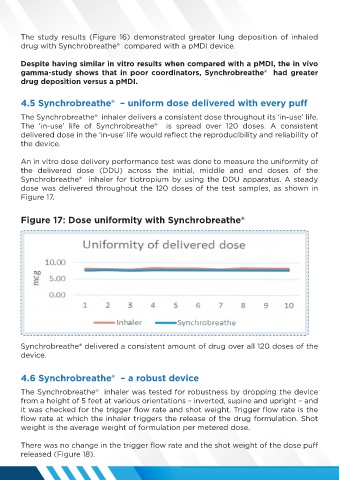
        An in vitro dose delivery performance test was done to measure the uniformity of
        the delivered  dose (DDU)  across the  initial,  middle and end  doses  of the
        Synchrobreathe®  inhaler for tiotropium by using the DDU apparatus. A steady
        dose was delivered throughout the 120 doses of the test samples, as shown in
        Figure 17.


        Figure 17: Dose uniformity with Synchrobreathe®


        Synchrobreathe® delivered a consistent amount of drug over all 120 doses of the
        device.


        4.6 Synchrobreathe®  – a robust device

        The Synchrobreathe®  inhaler was tested for robustness by dropping the device
        from a height of 5 feet at various orientations – inverted, supine and upright – and
        it was checked for the trigger flow rate and shot weight. Trigger flow rate is the
        flow rate at which the inhaler triggers the release of the drug formulation. Shot
        weight is the average weight of formulation per metered dose.

        There was no change in the trigger flow rate and the shot weight of the dose pu
        released (Figure 18).

