


Page 8 - COPD - Training Manual - Module 4
P. 8
The Synchrobreathe® inhaler was also tested for robustness by storing it at 50°C,
        with room humidity being 75%, and it was checked for trigger flow rate and shot
        weight (Figure 19). There was no change in the trigger flow rate and the shot
        weight of the dose pu  released.


        The data above show that Synchrobreathe® is a robust device that would
        withstand patient device-abuse scenarios.


        4.7 Synchrobreathe®  device-handling study in patients

        An open-label, prospective, comparative, multicentre study in 460 subjects
        [healthy volunteers (59), asthma (239), COPD (162)] was conducted to evaluate
        the Synchrobreathe®  inhaler (versus a pMDI) in terms of device handling, human
        factors, ease of use, errors and participant perceptions.


        Current or past users of BAIs were excluded. In the study, data was captured on
        day 0 (visit 1) and at the end of the treatment period on day 14 (visit 2).


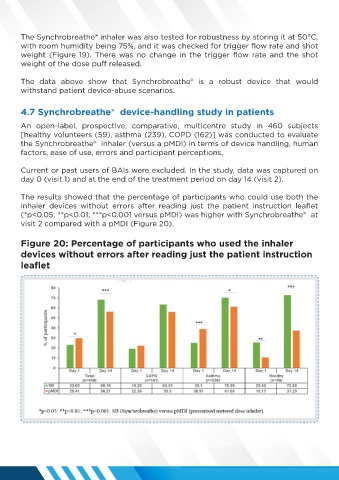
        The results showed that the percentage of participants who could use both the
        inhaler devices without errors after reading just the patient instruction leaflet
        (*p<0.05; **p<0.01; ***p<0.001 versus pMDI) was higher with Synchrobreathe®  at
        visit 2 compared with a pMDI (Figure 20).


        Figure 20: Percentage of participants who used the inhaler
        devices without errors after reading just the patient instruction

        leaflet

