


Page 59 - Human Environment Interface (3)
P. 59
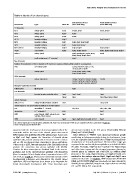
Brain Barrier Integrity and Development in the Rat

Table 4. Identity of ion channel genes.

Channel ID       Type                                       Gene ID     E15 Enriched Genes                           Adult Enriched Genes
                                                                        (from RNA-Seq)                               (from RNA-Seq)
                                                                                                                     Kcna1, Kcnab1
K+ Channels
                                                                                                                     Kcnj11, Kcnj13
Kv1.1            voltage-gated                              Kcna1       Kcnab3, Kcna5
                                                                                                                     Kcnj13, Kcnj11
Kv1.3            voltage-gated                              Kcna3       Kcna3                                        Kcnk1, Kcnk4, Kcnk9, Kcn`12, Kcnk15
                                                                                                                     Kcnd3
Kv1.6            voltage-gated                              Kcna6       Kcna6
                                                                                                                     Cacnb4
Kir 7.1          inwardly-rectifying                        Kcnj13
                                                                                                                     P2ry1,
Kir3.4           inwardly-rectifying                        Kcnj5       Kcnj2, Kcnj3, Kcnj5, Kcnj8                   Trpv4
                                                                                                                     Trpc1,Trpc2, Trpm3, Trpm7
Kir1.1           inwardly-rectifying                        Kcnj1       Kcnj2, Kcnj9, Kcnj12                         Clcn2, Clcn4
                                                                                                                     Clic2, Clic5, Clic6
Kir1.3 (Kir4.2)  inwardly-rectifying                        Kcnj15      Kcnj12, Kcnj15                               Best3
                                                                                                                     Aqp1
TASK1            acid sensitive                             Kcnk3       Kcnk2, Kcnk6, Kcnk10                         Aqp4
Other K+         voltage gated
                                                                        Kcnb2, Kcnd1,Kcne3, Kcnh3, Kcns3,
                 small conductance Ca2+ activated                       Kcnq2, Kcnq3, Kcnq4, Kcnv2

                                                                        Kcnn2

Na+ channels

Evidence for involvement of these channels in CP secretion is equivocal. Almost all Na transfer is via transporters

ENaC             not voltage-gated                                      Scnn1g (very low counts at E15,
                                                                        not detected in adult)

                 voltage-gated                                          Scn2b, Scn3a, Scn4a, Scn4b,
                                                                        Scn5a, Scn8a, Scn9a

Ca2+ channels

                 voltage-dependent                                      Cacng4, Cacna2d3, Cacna1i, Cacng8,
                                                                        Cacnb2, Cacna1g, Cacna1h, Cacna1e,
                                                                        Cacng7, Cacna1c, Cacna1a, Cacna1b

Receptor-operated channels

Purinoceptors    ligand gated                                           P2rx1

TRP channels

                 transient receptor potential cation        Trpv4       Trpv2, Trpv6

                                                            Trpm3       Trpc3

Anion channels

VRAC (CLC-2)     voltage-sensitive/volume activated         Clcn2

Anion channels not previously identified in choroid plexus

CLIC intracellular Cl2 channels                                         Clic, Clic4

Bestrophins      Ca2+ activated Cl2                         Best3

AQP1             water channel, cGMP- activated, non- Aqp1
                 selective cation channel

AQP4             water channel                              Aqp4        Aqp3, Aqp8 (only detectable at E15)

Ion channel expression in choroid plexus epithelial cells. Kcnj1 was not detected in RNA-Seq. A comprehensive list is presented in Table S2.
doi:10.1371/journal.pone.0065629.t004

associated with the development of neuroependymal cells of the          detected and enriched in the E15 plexus 22-fold (Gli3), 302-fold
ventricular wall at the root of the choroid plexus that control         (Emx1) and 3.6-fold (Emx2).
differentiation into epithelial cells of the plexus proper. Some, such
as Ngn2 and Foxg1 oppose the formation of choroid plexus                   Mice deficient in TWSG1 have abnormal forebrain growth
epithelial cells, instead causing cells to become neural in nature      manifesting as holoprosencephaly during its development, how-
and we did not detected these transcripts in plexus epithelium.         ever, the expression and potential roles of Twsg1 in postnatal brain
Others such as E2f5, Pcna and members of the Hes family actively        development are less well understood. We found that Twsg1 was
promote the conversion into plexus epithelial cells [25,26].            expressed in the rat choroid plexus epithelium, enriched 2.2-fold in
Proteins for these transcripts are localised both in the neuroe-        the adult. Previously, Twsg1 has been reported in the hippocampus
pendyma and in the choroid plexus epithelial cells themselves           and other brain regions with the strongest expression observed in
(these transcripts did not display altered expression between E15       choroid plexus in embryos and adult [28]. In addition Bmp3
and adult, see Table 1). Many genes traditionally associated with       (detected at E15 only), Bmp5 (16-fold), and Bmp8a (44-fold) were
developmental milestones were detected in the choroid plexus            enriched in the embryo whereas Bmp2, Bmp6 and Bmp15 were
epithelium: Gli3 and Emx have been shown to be important for            enriched in the adult – see Table 1. BMP antagonists CHORDIN
dorsal telencehpalic development [27]. These transcripts were           (Chrd) and NOGGIN (Nog) have previously not been detected in
                                                                        choroid plexus epithelium, however we report them as enriched
                                                                        2.3- and 95-fold at E15 respectively.

PLOS ONE | www.plosone.org                                              6 July 2013 | Volume 8 | Issue 7 | e65629

