


Page 26 - Human Environment Interface (4)
P. 26
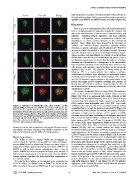
Surface Chemistry Directs Protein Remodeling

Figure 3. Adhesion of MC3T3-E1 cells after 3 hours on FN                    highly dependent on surface chemistry and with enhanced level on
coated SAMs. To identify each SAM the percentage of OH groups has           the hydrophilic surfaces. Further, immunofluorescence was used to
been used. First column shows F-actin cytoskeleton, second one the          spatially locate MMP2 and MMP9 during cell culture (Figure S6).
distribution of focal adhesion protein vinculin and its incorporation into
focal contact plaques, which is enhanced as the fraction of OH groups       Discussion
increases (see e.g. peripheral organization of well-defined focal contacts
in k) and n)). The third column is the superposition of the other two          There is a lack of understanding of the cell-material interaction
ones. The scale bar in a) is 50 mm.                                         from an integrated point of view that includes the amount and
doi:10.1371/journal.pone.0019610.g003                                       state of the adsorbed layer of proteins on the material surface, cell
                                                                            adhesion - including integrin expression and focal adhesion
However, cells are able to synthesize and deposit FN matrix more            formation - cell signaling, matrix reorganization, secretion and
abundantly and better organized into fibrillar networks on the              degradation, i.e. matrix protein dynamics at the cell-material
hydroxyl terminated and the 70%-OH SAMs surfaces.                           interface. Some efforts have been devoted in the literature to
                                                                            correlate the material surface properties, especially surface
Matrix degradation                                                          chemistry, to protein adsorption and cell adhesion [37–40]. Here
   The ability of cells to degrade ECM was investigated by                  we present results that provide a link between surface chemistry
                                                                            and cell-mediated matrix protein remodeling (including reorgani-
characterizing the expression of two different matrix metallopro-           zation, secretion and degradation) on a family of model surfaces
teinases (MMPs) and correlated with Runx2 expression. Figure 6              (SAMs) with controlled ratio of methyl/hydroxyl groups. From a
shows characteristic western blot bands for Runx2, MMP2 and                 mechanistic point of view, it is known that the influence of surface
MMP9 as well as their relative quantification after 1 day of                chemistry on cell behavior is a consequence of the intermediate
culture. MMP9 and Runx2 expression increases as the fraction of             layer of proteins adsorbed on the material surface. That is to say,
hydroxyl terminated groups in the surface does. However, MMP2               cells interact with synthetic material surfaces via the previously
remain constant regardless the hydroxyl/methyl composition of               deposited layer of FN. The sequence of events would be the
the material surface.                                                       following: FN is a macromolecule that display a globular
                                                                            conformation in solution; upon adsorption on a particular surface
   To gain further insights, we investigated gene expression by             chemistry, interactions between the chemical groups of the surface
RT-PCR (Figure 7). Similar levels of MMP2 are found on the                  and the FN domains triggers changes in the conformation of the
different surfaces. By contrast, MMP9 and Runx2 expressions are             protein that might lead to complete unfolding and exposure of
                                                                            groups that were hidden in solution. Consequently, the effect of
                                                                            the material surface chemistry is indirectly received by cells via the
                                                                            adsorbed layer of FN.

                                                                               The amount of adsorbed FN on the mixed CH3/OH surfaces is
                                                                            lower as the fraction of hydroxyl terminated chains increases
                                                                            (Figure 1b). This is in agreement with results obtained on this
                                                                            family of SAMs by radiolabeling the protein [41]. That is to say, it
                                                                            is known that FN is adsorbed in higher amount on hydrophobic
                                                                            (CH3) surfaces than hydrophilic ones (OH) [23]. Our results
                                                                            established the existence of a linear correlation between surface
                                                                            wettability (Figure 1a) and the density of adsorbed FN (Figure 1b)
                                                                            for this family of mixed SAMs. By contrast, the activity of FN after
                                                                            adsorption is higher as the fraction of OH groups on SAMs
                                                                            increased due to the better availability of cell adhesion domains of
                                                                            FN, as it is proved by the HFN7.1 antibody directed to the flexible
                                                                            linker between the 9th and 10th type III repeats of FN [29]. That
                                                                            the activity of FN upon adsorption on SAMs was greater on OH
                                                                            terminated SAMs than CH3 terminated ones was previously
                                                                            assessed [23,42], and our results confirm the finely tuned
                                                                            chemistry-mediated conformation of FN that leads to a monoton-
                                                                            ically dependence of FN activity on surface composition, as the
                                                                            CH3/OH balance on the surface is altered (Figure 1d). It is known
                                                                            that FN has a compact folded structure in physiological buffer that
                                                                            is stabilized through ionic interactions between arms [43]. FN
                                                                            interactions with chemical groups of the substrate (CH3) give rise
                                                                            to conformational changes in the molecule that must lead to the
                                                                            occlusion of the cell binding domains (III9–10). It is likely that FN
                                                                            orients at the CH3 surface, so that its hydrophobic segments
                                                                            interact with the methyl groups in PEA, maybe throughout the
                                                                            heparin-binding fragment [44]. Different supramolecular organi-
                                                                            zation of the protein at the material interface is also reflected in
                                                                            protein distribution on the material surface, as directly observed
                                                                            with AFM images in Figure 2 and Figures S1, S2, S3: globular
                                                                            aggregates on the hydrophilic surfaces and fibrillar-like structures
                                                                            on the methyl terminated SAMs.

PLoS ONE | www.plosone.org                                                  4 May 2011 | Volume 6 | Issue 5 | e19610

