


Page 14 - REC :: M.E. CS Curriculum and Syllabus - R2019
P. 14
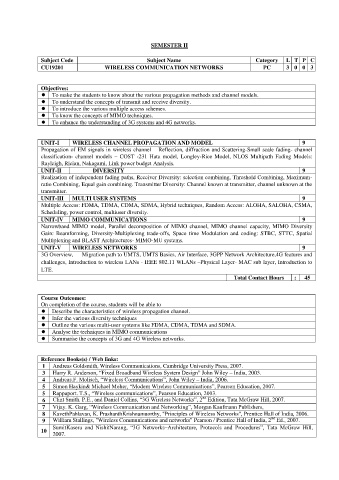
SEMESTER II
Subject Code Subject Name Category L T P C
CU19201 WIRELESS COMMUNICATION NETWORKS PC 3 0 0 3
Objectives:
To make the students to know about the various propagation methods and channel models.
To understand the concepts of transmit and receive diversity.
To introduce the various multiple access schemes.
To know the concepts of MIMO techniques.
To enhance the understanding of 3G systems and 4G networks.
UNIT-I WIRELESS CHANNEL PROPAGATION AND MODEL 9
Propagation of EM signals in wireless channel – Reflection, diffraction and Scattering-Small scale fading- channel
classification- channel models – COST -231 Hata model, Longley-Rice Model, NLOS Multipath Fading Models:
Rayleigh, Rician, Nakagami, Link power budget Analysis.
UNIT-II DIVERSITY 9
Realization of independent fading paths, Receiver Diversity: selection combining, Threshold Combining, Maximum-
ratio Combining, Equal gain combining. Transmitter Diversity: Channel known at transmitter, channel unknown at the
transmitter.
UNIT-III MULTI USER SYSTEMS 9
Multiple Access: FDMA, TDMA, CDMA, SDMA, Hybrid techniques, Random Access: ALOHA, SALOHA, CSMA,
Scheduling, power control, multiuser diversity.
UNIT-IV MIMO COMMUNICATIONS 9
Narrowband MIMO model, Parallel decomposition of MIMO channel, MIMO channel capacity, MIMO Diversity
Gain: Beamforming, Diversity-Multiplexing trade-offs, Space time Modulation and coding: STBC, STTC, Spatial
Multiplexing and BLAST Architectures- MIMO-MU systems.
UNIT-V WIRELESS NETWORKS 9
3G Overview, Migration path to UMTS, UMTS Basics, Air Interface, 3GPP Network Architecture,4G features and
challenges, Introduction to wireless LANs - IEEE 802.11 WLANs –Physical Layer- MAC sub layer, Introduction to
LTE.
Total Contact Hours : 45
Course Outcomes:
On completion of the course, students will be able to
Describe the characteristics of wireless propagation channel.
Infer the various diversity techniques
Outline the various multi-user systems like FDMA, CDMA, TDMA and SDMA.
Analyse the techniques in MIMO communications
Summarise the concepts of 3G and 4G Wireless networks.
Reference Books(s) / Web links:
1 Andreas Goldsmith, Wireless Communications, Cambridge University Press, 2007.
3 Harry R. Anderson, “Fixed Broadband Wireless System Design” John Wiley – India, 2003.
4 Andreas.F. Molisch, “Wireless Communications”, John Wiley – India, 2006.
5 Simon Haykin& Michael Moher, “Modern Wireless Communications”, Pearson Education, 2007.
5 Rappaport. T.S., “Wireless communications”, Pearson Education, 2003.
nd
6 Clint Smith. P.E., and Daniel Collins, “3G Wireless Networks”, 2 Edition, Tata McGraw Hill, 2007.
7 Vijay. K. Garg, “Wireless Communication and Networking”, Morgan Kaufmann Publishers,
8 KavethPahlavan, K. PrashanthKrishnamuorthy, "Principles of Wireless Networks", Prentice Hall of India, 2006.
nd
9 William Stallings, "Wireless Communications and networks" Pearson / Prentice Hall of India, 2 Ed., 2007.
SumitKasera and NishitNarang, “3G Networks–Architecture, Protocols and Procedures”, Tata McGraw Hill,
10
2007.

