


Page 16 - REC :: M.E. CS Curriculum and Syllabus - R2019
P. 16
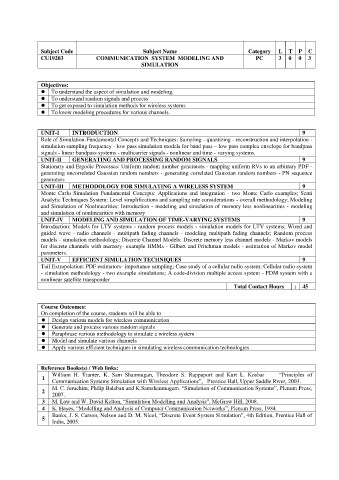
Subject Code Subject Name Category L T P C
CU19203 COMMUNICATION SYSTEM MODELING AND PC 3 0 0 3
SIMULATION
Objectives:
To understand the aspect of simulation and modeling.
To understand random signals and process
To get exposed to simulation methods for wireless systems
To know modeling procedures for various channels.
UNIT-I INTRODUCTION 9
Role of Simulation-Fundamental Concepts and Techniques: Sampling - quantizing - reconstruction and interpolation -
simulation sampling frequency - low pass simulation models for band pass – low pass complex envelope for bandpass
signals - linear bandpass systems - multicarrier signals - nonlinear and time - varying systems.
UNIT-II GENERATING AND PROCESSING RANDOM SIGNALS 9
Stationary and Ergodic Processes: Uniform random number generators - mapping uniform RVs to an arbitrary PDF -
generating uncorrelated Gaussian random numbers - generating correlated Gaussian random numbers - PN sequence
generators
UNIT-III METHODOLOGY FOR SIMULATING A WIRELESS SYSTEM 9
Monte Carlo Simulation Fundamental Concepts: Applications and integration - two Monte Carlo examples; Semi
Analytic Techniques System: Level simplifications and sampling rate considerations - overall methodology; Modeling
and Simulation of Nonlinearities: Introduction - modeling and simulation of memory less nonlinearities - modeling
and simulation of nonlinearities with memory
UNIT-IV MODELING AND SIMULATION OF TIME-VARYING SYSTEMS 9
Introduction: Models for LTV systems - random process models - simulation models for LTV systems; Wired and
guided wave - radio channels - multipath fading channels - modeling multipath fading channels; Random process
models - simulation methodology; Discrete Channel Models: Discrete memory less channel models - Markov models
for discrete channels with memory- example HMMs - Gilbert and Fritchman models - estimation of Markov model
parameters.
UNIT-V EFFICIENT SIMULATION TECHNIQUES 9
Tail Extrapolation: PDF estimators- importance sampling; Case study of a cellular radio system; Cellular radio system
- simulation methodology - two example simulations; A code-division multiple access system - FDM system with a
nonlinear satellite transponder
Total Contact Hours : 45
Course Outcomes:
On completion of the course, students will be able to
Design various models for wireless communication
Generate and process various random signals
Paraphrase various methodology to simulate a wireless system
Model and simulate various channels
Apply various efficient techniques in simulating wireless communication technologies
Reference Books(s) / Web links:
William H. Tranter, K. Sam Shanmugan, Theodore S. Rappaport and Kurt L. Kosbar “Principles of
1
Communication Systems Simulation with Wireless Applications”, Prentice Hall, Upper Saddle River, 2003.
M. C. Jeruchim, Philip Balaban and K.Samshanmugam. “Simulation of Communication Systems”, Plenum Press,
2
2007.
3 M. Law and W. David Kelton, “Simulation Modelling and Analysis”, McGraw Hill, 2008.
4 K. Hayes, “Modelling and Analysis of Computer Communication Networks”, Plenum Press, 1984.
Banks, J. S. Carson, Nelson and D. M. Nicol, “Discrete Event System Simulation”, 4th Edition, Prentice Hall of
5
India, 2005.

