


Page 186 - Applied Statistics with R
P. 186
186                                 CHAPTER 10. MODEL BUILDING

                                 10.1     Family, Form, and Fit


                                 When modeling data, there are a number of choices that need to be made.

                                    • What family of models will be considered?
                                    • What form of the model will be used?
                                    • How will the model be fit?


                                 Let’s work backwards and discuss each of these.


                                 10.1.1   Fit

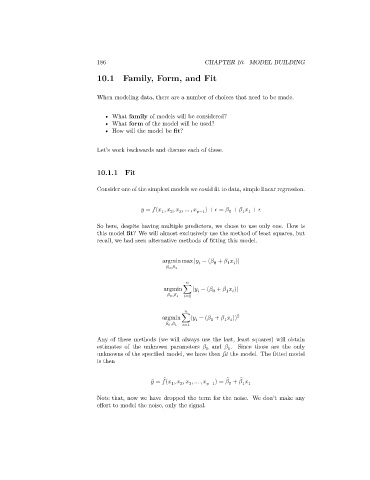
                                 Consider one of the simplest models we could fit to data, simple linear regression.


                                                   =   (   ,    ,    , … ,      −1 ) +    =    +       +
                                                            3
                                                      1
                                                         2
                                                                                 1 1
                                                                             0
                                 So here, despite having multiple predictors, we chose to use only one. How is
                                 this model fit? We will almost exclusively use the method of least squares, but
                                 recall, we had seen alternative methods of fitting this model.
                                                       argmin max |   − (   +       )|

                                                                            1
                                                                        0
                                                           0 ,   1

                                                       argmin ∑ |   − (   +       )|

                                                                       0
                                                                            1
                                                           0 ,   1    =1

                                                       argmin ∑(   − (   +       )) 2
                                                                       0
                                                                           1

                                                           0 ,   1    =1
                                 Any of these methods (we will always use the last, least squares) will obtain
                                 estimates of the unknown parameters    and    . Since those are the only
                                                                     0
                                                                            1
                                 unknowns of the specified model, we have then fit the model. The fitted model
                                 is then

                                                                             ̂
                                                        ̂
                                                                                 ̂
                                                    ̂    =   (   ,    ,    , … ,      −1 ) =    +
                                                             2
                                                                3
                                                                             0
                                                                                 1 1
                                                          1
                                 Note that, now we have dropped the term for the noise. We don’t make any
                                 effort to model the noise, only the signal.

