


Page 205 - Applied Statistics with R
P. 205
11.2. INTERACTIONS                                                205


                      int_dom = coef(mpg_disp_add)[1] + coef(mpg_disp_add)[3]

                      slope_for = coef(mpg_disp_add)[2]
                      slope_dom = coef(mpg_disp_add)[2]

                      plot(mpg ~ disp, data = autompg, col = domestic + 1, pch = domestic + 1)
                      abline(int_for, slope_for, col = 1, lty = 1, lwd = 2) # add line for foreign cars
                      abline(int_dom, slope_dom, col = 2, lty = 2, lwd = 2) # add line for domestic cars
                      legend("topright", c("Foreign", "Domestic"), pch = c(1, 2), col = c(1, 2))


                                                                               Foreign
                                                                               Domestic
                             40


                        mpg  30


                             20


                             10


                                    100          200           300          400
                                                         disp


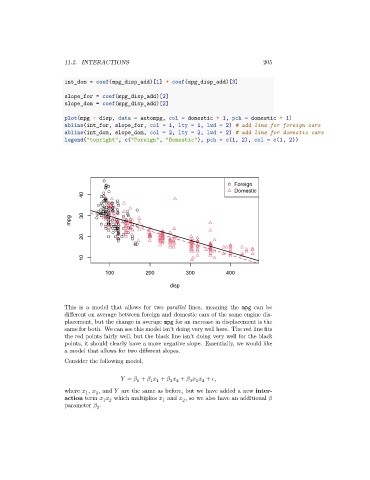
                      This is a model that allows for two parallel lines, meaning the mpg can be
                      different on average between foreign and domestic cars of the same engine dis-
                      placement, but the change in average mpg for an increase in displacement is the
                      same for both. We can see this model isn’t doing very well here. The red line fits
                      the red points fairly well, but the black line isn’t doing very well for the black
                      points, it should clearly have a more negative slope. Essentially, we would like
                      a model that allows for two different slopes.
                      Consider the following model,


                                            =    +       +       +          +   ,
                                              0
                                                         2 2
                                                   1 1
                                                                3 1 2
                      where    ,    , and    are the same as before, but we have added a new inter-
                             1
                                 2
                      action term       which multiplies    and    , so we also have an additional
                                                             2
                                                       1
                                   1 2
                      parameter    .
                                 3

