


Page 233 - Applied Statistics with R
P. 233
12.2. TWO-SAMPLE T-TEST                                           233


                         • The observations follow a normal distribution. The mean of each group
                           is different.
                         • Equal variance for each group.
                         • Independence. Which is believable if groups were randomly assigned.


                      Later, we will investigate the normal and equal variance assumptions. For now,
                      we will continue to assume they are reasonable.

                      The natural question to ask: Is there a difference between the two groups? The
                      specific question we’ll answer: Are the means of the two groups different?
                      Mathematically, that is


                                              ∶    =    2  vs    ∶    ≠    2
                                                             1
                                                                 1
                                                1
                                            0
                      For the stated model and assuming the null hypothesis is true, the    test statistic
                      would follow a    distribution with degrees of freedom    +    − 2.
                                                                      1
                                                                           2
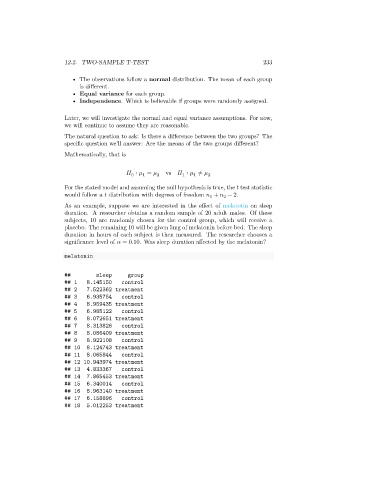
                      As an example, suppose we are interested in the effect of melatotin on sleep
                      duration. A researcher obtains a random sample of 20 adult males. Of these
                      subjects, 10 are randomly chosen for the control group, which will receive a
                      placebo. The remaining 10 will be given 5mg of melatonin before bed. The sleep
                      duration in hours of each subject is then measured. The researcher chooses a
                      significance level of    = 0.10. Was sleep duration affected by the melatonin?

                      melatonin


                      ##         sleep     group
                      ## 1    8.145150   control
                      ## 2    7.522362 treatment
                      ## 3    6.935754   control
                      ## 4    8.959435 treatment
                      ## 5    6.985122   control
                      ## 6    8.072651 treatment
                      ## 7    8.313826   control
                      ## 8    8.086409 treatment
                      ## 9    8.922108   control
                      ## 10   8.124743 treatment
                      ## 11   8.065844   control
                      ## 12 10.943974 treatment
                      ## 13   4.833367   control
                      ## 14   7.865453 treatment
                      ## 15   6.340014   control
                      ## 16   8.963140 treatment
                      ## 17   6.158896   control
                      ## 18   5.012253 treatment

