


Page 237 - Applied Statistics with R
P. 237
12.3. ONE-WAY ANOVA                                               237


                         •    is the overall sample mean.
                            ̄
                            2
                         •    is the sample variance of group   .

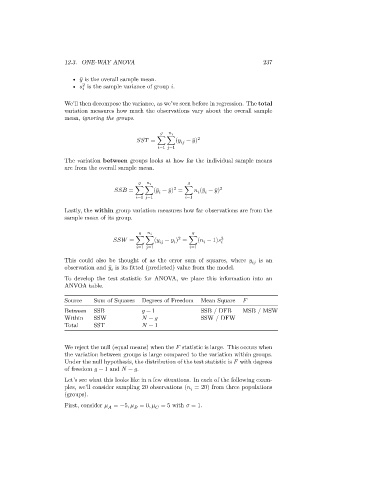
                      We’ll then decompose the variance, as we’ve seen before in regression. The total
                      variation measures how much the observations vary about the overall sample
                      mean, ignoring the groups.


                                                     = ∑ ∑(   − ̄) 2


                                                       =1   =1
                      The variation between groups looks at how far the individual sample means
                      are from the overall sample mean.


                                                          2


                                              = ∑ ∑( ̄ − ̄) = ∑    ( ̄ − ̄) 2


                                                =1   =1         =1
                      Lastly, the within group variation measures how far observations are from the
                      sample mean of its group.

                                                            2
                                             = ∑ ∑(   − ̄   ) = ∑(   − 1)   2


                                                =1   =1           =1
                      This could also be thought of as the error sum of squares, where          is an

                      observation and ̄ is its fitted (predicted) value from the model.

                      To develop the test statistic for ANOVA, we place this information into an
                      ANVOA table.
                      Source    Sum of Squares  Degrees of Freedom  Mean Square
                      Between   SSB                − 1             SSB / DFB     MSB / MSW
                      Within    SSW                −               SSW / DFW
                      Total     SST                − 1


                      We reject the null (equal means) when the    statistic is large. This occurs when
                      the variation between groups is large compared to the variation within groups.
                      Under the null hypothesis, the distribution of the test statistic is    with degrees
                      of freedom    − 1 and    −   .
                      Let’s see what this looks like in a few situations. In each of the following exam-
                      ples, we’ll consider sampling 20 observations (   = 20) from three populations

                      (groups).
                      First, consider    = −5,    = 0,    = 5 with    = 1.


