


Page 228 - Applied Statistics with R
P. 228
228 CHAPTER 11. CATEGORICAL PREDICTORS AND INTERACTIONS


                                 mean(resid(big_model) ^ 2)


                                 ## [1] 14.74053


                                 mean(resid(two_way_int_mod) ^ 2)


                                 ## [1] 14.81259

                                 However, it is not much smaller. We could even say that, the difference is
                                 insignificant. This is an idea we will return to later in greater detail.
                                 Now that we have chosen the model without the three-way interaction, can we
                                 go further? Do we need the two-way interactions? Let’s test

                                                             ∶    =    =    = 0.
                                                               4
                                                           0
                                                                        6
                                                                    5
                                 Remember we already chose    = 0, so,
                                                           7
                                    • Full Model:    =    +       +       +       +          +          +          +
                                                                 2 2
                                                           1 1
                                                      0
                                                                       3 3
                                                                                              6 2 3
                                                                                      5 1 3
                                                                             4 1 2
                                    • Null Model:    =    +       +       +       +
                                                                  2 2
                                                           1 1
                                                       0
                                                                        3 3
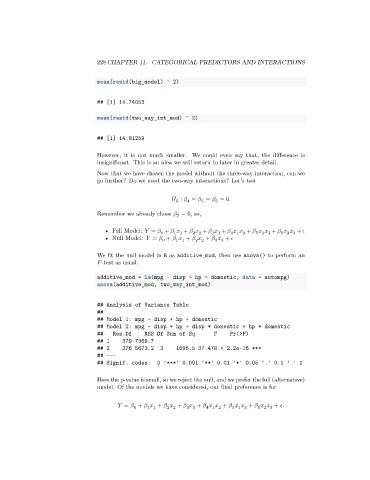
                                 We fit the null model in R as additive_mod, then use anova() to perform an
                                   -test as usual.
                                 additive_mod = lm(mpg ~ disp + hp + domestic, data = autompg)
                                 anova(additive_mod, two_way_int_mod)
                                 ## Analysis of Variance Table
                                 ##
                                 ## Model 1: mpg ~ disp + hp + domestic
                                 ## Model 2: mpg ~ disp * hp + disp * domestic + hp * domestic
                                 ##   Res.Df     RSS Df Sum of Sq       F    Pr(>F)
                                 ## 1     379 7369.7
                                 ## 2     376 5673.2  3    1696.5 37.478 < 2.2e-16 ***
                                 ## ---
                                 ## Signif. codes:   0 '***' 0.001 '**' 0.01 '*' 0.05 '.' 0.1 ' ' 1


                                 Here the p-value is small, so we reject the null, and we prefer the full (alternative)
                                 model. Of the models we have considered, our final preference is for


                                           =    +       +       +       +          +          +          +   .
                                                               3 3
                                                                                      6 2 3
                                                        2 2
                                                                              5 1 3
                                                                     4 1 2
                                             0
                                                  1 1

