


Page 286 - Applied Statistics with R
P. 286
286                             CHAPTER 13. MODEL DIAGNOSTICS


                                 lev_ex = data.frame(
                                   x1 = c(0, 11, 11, 7, 4, 10, 5, 8),
                                   x2 = c(1, 5, 4, 3, 1, 4, 4, 2),
                                   y  = c(11, 15, 13, 14, 0, 19, 16, 8))

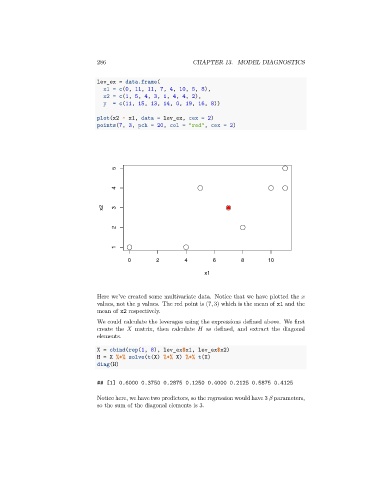
                                 plot(x2 ~ x1, data = lev_ex, cex = 2)
                                 points(7, 3, pch = 20, col = "red", cex = 2)


                                       5


                                       4


                                   x2  3


                                       2


                                       1
                                           0         2        4        6         8        10

                                                                     x1


                                 Here we’ve created some multivariate data. Notice that we have plotted the
                                 values, not the    values. The red point is (7, 3) which is the mean of x1 and the
                                 mean of x2 respectively.
                                 We could calculate the leverages using the expressions defined above. We first
                                 create the    matrix, then calculate    as defined, and extract the diagonal
                                 elements.

                                 X = cbind(rep(1, 8), lev_ex$x1, lev_ex$x2)
                                 H = X %*% solve(t(X) %*% X) %*% t(X)
                                 diag(H)


                                 ## [1] 0.6000 0.3750 0.2875 0.1250 0.4000 0.2125 0.5875 0.4125


                                 Notice here, we have two predictors, so the regression would have 3    parameters,
                                 so the sum of the diagonal elements is 3.

