


Page 291 - Applied Statistics with R
P. 291
13.3. UNUSUAL OBSERVATIONS                                        291


                      when    is large.
                      We can use this fact to identify “large” residuals. For example, standardized
                      residuals greater than 2 in magnitude should only happen approximately 5 per-
                      cent of the time.
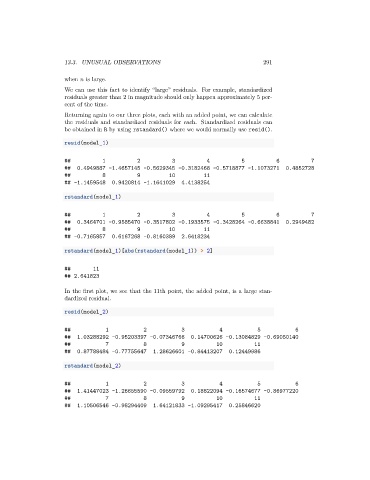
                      Returning again to our three plots, each with an added point, we can calculate
                      the residuals and standardized residuals for each. Standardized residuals can
                      be obtained in R by using rstandard() where we would normally use resid().

                      resid(model_1)

                      ##           1          2           3          4           5          6           7
                      ##   0.4949887 -1.4657145 -0.5629345 -0.3182468 -0.5718877 -1.1073271     0.4852728
                      ##           8          9          10         11
                      ## -1.1459548   0.9420814 -1.1641029   4.4138254

                      rstandard(model_1)


                      ##           1          2           3          4           5          6           7
                      ##   0.3464701 -0.9585470 -0.3517802 -0.1933575 -0.3428264 -0.6638841     0.2949482
                      ##           8          9          10         11
                      ## -0.7165857   0.6167268 -0.8160389   2.6418234

                      rstandard(model_1)[abs(rstandard(model_1)) > 2]


                      ##        11
                      ## 2.641823

                      In the first plot, we see that the 11th point, the added point, is a large stan-
                      dardized residual.

                      resid(model_2)

                      ##            1            2           3            4           5            6
                      ##   1.03288292 -0.95203397 -0.07346766   0.14700626 -0.13084829 -0.69050140
                      ##            7            8           9           10          11
                      ##   0.87788484 -0.77755647   1.28626601 -0.84413207   0.12449986

                      rstandard(model_2)

                      ##            1            2           3            4           5            6
                      ##   1.41447023 -1.26655590 -0.09559792   0.18822094 -0.16574677 -0.86977220
                      ##            7            8           9           10          11
                      ##   1.10506546 -0.98294409   1.64121833 -1.09295417   0.25846620

