


Page 281 - Applied Statistics with R
P. 281
13.2. CHECKING ASSUMPTIONS                                        281


                      ##   Shapiro-Wilk normality test
                      ##
                      ## data:   rexp(25)
                      ## W = 0.71164, p-value = 1.05e-05


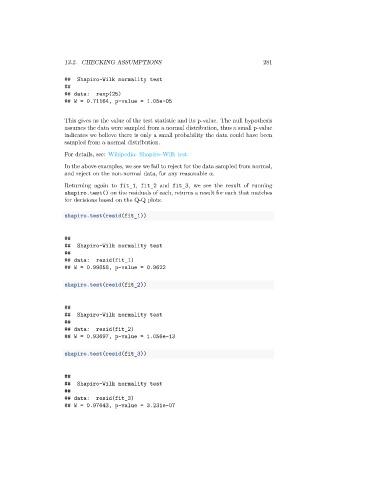
                      This gives us the value of the test statistic and its p-value. The null hypothesis
                      assumes the data were sampled from a normal distribution, thus a small p-value
                      indicates we believe there is only a small probability the data could have been
                      sampled from a normal distribution.
                      For details, see: Wikipedia: Shapiro–Wilk test.

                      In the above examples, we see we fail to reject for the data sampled from normal,
                      and reject on the non-normal data, for any reasonable   .

                      Returning again to fit_1, fit_2 and fit_3, we see the result of running
                      shapiro.test() on the residuals of each, returns a result for each that matches
                      for decisions based on the Q-Q plots.

                      shapiro.test(resid(fit_1))


                      ##
                      ##   Shapiro-Wilk normality test
                      ##
                      ## data:   resid(fit_1)
                      ## W = 0.99858, p-value = 0.9622


                      shapiro.test(resid(fit_2))


                      ##
                      ##   Shapiro-Wilk normality test
                      ##
                      ## data:   resid(fit_2)
                      ## W = 0.93697, p-value = 1.056e-13

                      shapiro.test(resid(fit_3))


                      ##
                      ##   Shapiro-Wilk normality test
                      ##
                      ## data:   resid(fit_3)
                      ## W = 0.97643, p-value = 3.231e-07

