


Page 43 - Applied Statistics with R
P. 43
3.2. DATA STRUCTURES                                               43


                      ex_list["e"]


                      ## $e
                      ##       [,1] [,2] [,3] [,4] [,5]
                      ## [1,]     1    0    0     0    0
                      ## [2,]     0    1    0     0    0
                      ## [3,]     0    0    1     0    0
                      ## [4,]     0    0    0     1    0
                      ## [5,]     0    0    0     0    1

                      ex_list[["e"]]


                      ##       [,1] [,2] [,3] [,4] [,5]
                      ## [1,]     1    0    0     0    0
                      ## [2,]     0    1    0     0    0
                      ## [3,]     0    0    1     0    0
                      ## [4,]     0    0    0     1    0
                      ## [5,]     0    0    0     0    1

                      ex_list$d


                      ## function(arg = 42) {print("Hello World!")}

                      ex_list$d(arg = 1)


                      ## [1] "Hello World!"


                      3.2.7   Data Frames

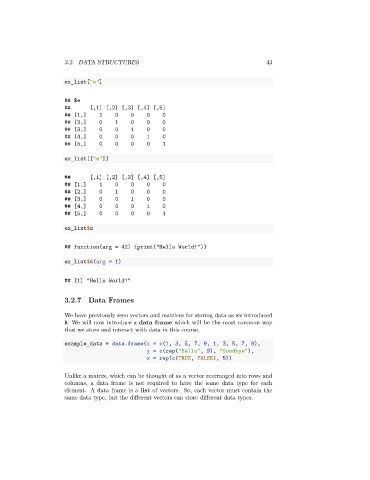
                      We have previously seen vectors and matrices for storing data as we introduced
                      R. We will now introduce a data frame which will be the most common way
                      that we store and interact with data in this course.

                      example_data = data.frame(x = c(1, 3, 5, 7, 9, 1, 3, 5, 7, 9),
                                                  y = c(rep("Hello", 9), "Goodbye"),
                                                  z = rep(c(TRUE, FALSE), 5))


                      Unlike a matrix, which can be thought of as a vector rearranged into rows and
                      columns, a data frame is not required to have the same data type for each
                      element. A data frame is a list of vectors. So, each vector must contain the
                      same data type, but the different vectors can store different data types.

