


Page 444 - Applied Statistics with R
P. 444
444                           CHAPTER 17. LOGISTIC REGRESSION


                                 set.seed(42)
                                 # spam_idx = sample(nrow(spam), round(nrow(spam) / 2))
                                 spam_idx = sample(nrow(spam), 1000)
                                 spam_trn = spam[spam_idx, ]
                                 spam_tst = spam[-spam_idx, ]


                                 We’ve used a somewhat small train set relative to the total size of the dataset.
                                 In practice it should likely be larger, but this is simply to keep training time
                                 low for illustration and rendering of this document.

                                 fit_caps = glm(type ~ capitalTotal,
                                                 data = spam_trn, family = binomial)
                                 fit_selected = glm(type ~ edu + money + capitalTotal + charDollar,
                                                     data = spam_trn, family = binomial)
                                 fit_additive = glm(type ~ .,
                                                     data = spam_trn, family = binomial)
                                 fit_over = glm(type ~ capitalTotal * (.),
                                                 data = spam_trn, family = binomial, maxit = 50)


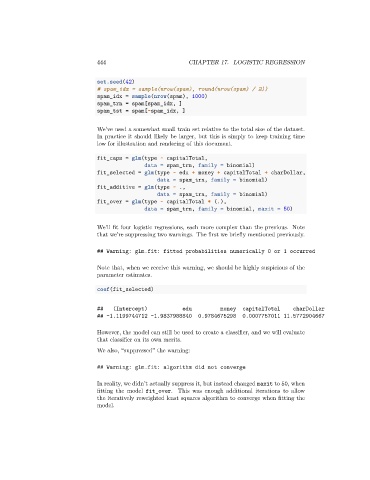
                                 We’ll fit four logistic regressions, each more complex than the previous. Note
                                 that we’re suppressing two warnings. The first we briefly mentioned previously.

                                 ## Warning: glm.fit: fitted probabilities numerically 0 or 1 occurred


                                 Note that, when we receive this warning, we should be highly suspicious of the
                                 parameter estimates.

                                 coef(fit_selected)


                                 ##   (Intercept)            edu          money  capitalTotal     charDollar
                                 ## -1.1199744712 -1.9837988840    0.9784675298  0.0007757011 11.5772904667


                                 However, the model can still be used to create a classifier, and we will evaluate
                                 that classifier on its own merits.

                                 We also, “suppressed” the warning:

                                 ## Warning: glm.fit: algorithm did not converge

                                 In reality, we didn’t actually suppress it, but instead changed maxit to 50, when
                                 fitting the model fit_over. This was enough additional iterations to allow
                                 the iteratively reweighted least squares algorithm to converge when fitting the
                                 model.

