


Page 443 - Applied Statistics with R
P. 443
17.4. CLASSIFICATION                                              443


                      ##   5  0       0     0         0  0.63  0      0.31      0.63  0.31  0.63     0.31
                      ##   6  0       0     0         0  1.85  0      0         1.85  0     0        0
                      ##   7  0       0     0         0  1.92  0      0         0     0     0.64     0.96
                      ##   8  0       0     0         0  1.88  0      0         1.88  0     0        0
                      ##   9  0.15    0     0.46      0  0.61  0      0.3       0     0.92  0.76     0.76
                      ## 10   0.06    0.12  0.77      0  0.19  0.32   0.38      0     0.06  0        0
                      ## # ... with 4,591 more rows, and 47 more variables: will <dbl>, people <dbl>,
                      ## #    report <dbl>, addresses <dbl>, free <dbl>, business <dbl>, email <dbl>,
                      ## #    you <dbl>, credit <dbl>, your <dbl>, font <dbl>, num000 <dbl>, money <dbl>,
                      ## #    hp <dbl>, hpl <dbl>, george <dbl>, num650 <dbl>, lab <dbl>, labs <dbl>,
                      ## #    telnet <dbl>, num857 <dbl>, data <dbl>, num415 <dbl>, num85 <dbl>,
                      ## #    technology <dbl>, num1999 <dbl>, parts <dbl>, pm <dbl>, direct <dbl>,
                      ## #    cs <dbl>, meeting <dbl>, original <dbl>, project <dbl>, re <dbl>,
                      ## #    edu <dbl>, table <dbl>, conference <dbl>, charSemicolon <dbl>,
                      ## #    charRoundbracket <dbl>, charSquarebracket <dbl>, charExclamation <dbl>,
                      ## #    charDollar <dbl>, charHash <dbl>, capitalAve <dbl>, capitalLong <dbl>,
                      ## #    capitalTotal <dbl>, type <fct>

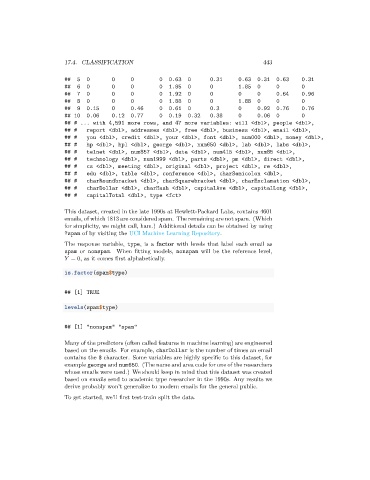
                      This dataset, created in the late 1990s at Hewlett-Packard Labs, contains 4601
                      emails, of which 1813 are considered spam. The remaining are not spam. (Which
                      for simplicity, we might call, ham.) Additional details can be obtained by using
                      ?spam of by visiting the UCI Machine Learning Repository.
                      The response variable, type, is a factor with levels that label each email as
                      spam or nonspam. When fitting models, nonspam will be the reference level,
                         = 0, as it comes first alphabetically.

                      is.factor(spam$type)


                      ## [1] TRUE

                      levels(spam$type)


                      ## [1] "nonspam" "spam"

                      Many of the predictors (often called features in machine learning) are engineered
                      based on the emails. For example, charDollar is the number of times an email
                      contains the $ character. Some variables are highly specific to this dataset, for
                      example george and num650. (The name and area code for one of the researchers
                      whose emails were used.) We should keep in mind that this dataset was created
                      based on emails send to academic type researcher in the 1990s. Any results we
                      derive probably won’t generalize to modern emails for the general public.
                      To get started, we’ll first test-train split the data.

