


Page 448 - Applied Statistics with R
P. 448
448                           CHAPTER 17. LOGISTIC REGRESSION


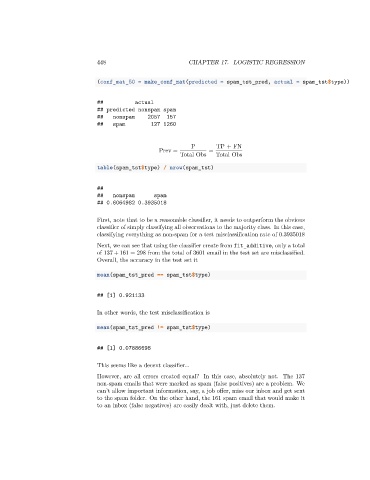
                                 (conf_mat_50 = make_conf_mat(predicted = spam_tst_pred, actual = spam_tst$type))


                                 ##           actual
                                 ## predicted nonspam spam
                                 ##   nonspam     2057  157
                                 ##   spam         127 1260


                                                                P        TP + FN
                                                      Prev =          =
                                                             Total Obs  Total Obs
                                 table(spam_tst$type) / nrow(spam_tst)


                                 ##
                                 ##   nonspam       spam
                                 ## 0.6064982 0.3935018


                                 First, note that to be a reasonable classifier, it needs to outperform the obvious
                                 classifier of simply classifying all observations to the majority class. In this case,
                                 classifying everything as non-spam for a test misclassification rate of 0.3935018
                                 Next, we can see that using the classifier create from fit_additive, only a total
                                 of 137 + 161 = 298 from the total of 3601 email in the test set are misclassified.
                                 Overall, the accuracy in the test set it

                                 mean(spam_tst_pred == spam_tst$type)


                                 ## [1] 0.921133


                                 In other words, the test misclassification is

                                 mean(spam_tst_pred != spam_tst$type)


                                 ## [1] 0.07886698


                                 This seems like a decent classifier…
                                 However, are all errors created equal? In this case, absolutely not. The 137
                                 non-spam emails that were marked as spam (false positives) are a problem. We
                                 can’t allow important information, say, a job offer, miss our inbox and get sent
                                 to the spam folder. On the other hand, the 161 spam email that would make it
                                 to an inbox (false negatives) are easily dealt with, just delete them.

