


Page 52 - Applied Statistics with R
P. 52
52                         CHAPTER 3. DATA AND PROGRAMMING


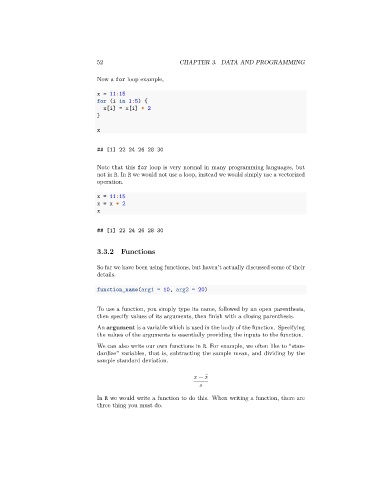
                                 Now a for loop example,

                                 x = 11:15
                                 for (i in 1:5) {
                                   x[i] = x[i] * 2
                                 }

                                 x


                                 ## [1] 22 24 26 28 30


                                 Note that this for loop is very normal in many programming languages, but
                                 not in R. In R we would not use a loop, instead we would simply use a vectorized
                                 operation.

                                 x = 11:15
                                 x = x * 2
                                 x


                                 ## [1] 22 24 26 28 30


                                 3.3.2   Functions

                                 So far we have been using functions, but haven’t actually discussed some of their
                                 details.

                                 function_name(arg1 = 10, arg2 = 20)


                                 To use a function, you simply type its name, followed by an open parenthesis,
                                 then specify values of its arguments, then finish with a closing parenthesis.
                                 An argument is a variable which is used in the body of the function. Specifying
                                 the values of the arguments is essentially providing the inputs to the function.

                                 We can also write our own functions in R. For example, we often like to “stan-
                                 dardize” variables, that is, subtracting the sample mean, and dividing by the
                                 sample standard deviation.

                                                                    − ̄


                                 In R we would write a function to do this. When writing a function, there are
                                 three thing you must do.

