


Page 70 - Applied Statistics with R
P. 70
70                 CHAPTER 5. PROBABILITY AND STATISTICS IN R


                                                                ̄    −
                                                              =  √  0  ∼     ,
                                                                 /        −1

                                           ∑                  1
                                                                           2
                                 where ̄ =     =1  and    = √     ∑(   − ̄  ) .


                                                               − 1
                                                                    =1
                                 A 100(1 −   )% confidence interval for    is given by,

                                                             ̄    ±      −1 (  /2)√

                                 where      −1 (  /2) is the critical value such that    (   >      −1 (  /2)) =   /2 for   −1
                                 degrees of freedom.


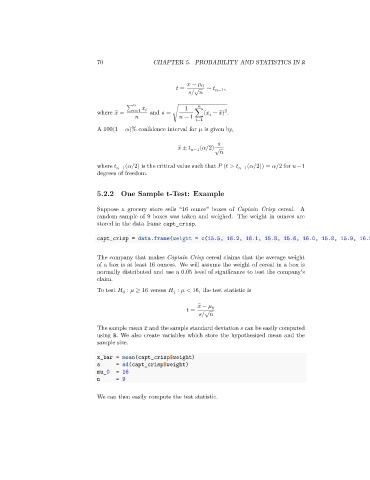
                                 5.2.2   One Sample t-Test: Example

                                 Suppose a grocery store sells “16 ounce” boxes of Captain Crisp cereal. A
                                 random sample of 9 boxes was taken and weighed. The weight in ounces are
                                 stored in the data frame capt_crisp.
                                 capt_crisp = data.frame(weight = c(15.5, 16.2, 16.1, 15.8, 15.6, 16.0, 15.8, 15.9, 16.2))


                                 The company that makes Captain Crisp cereal claims that the average weight
                                 of a box is at least 16 ounces. We will assume the weight of cereal in a box is
                                 normally distributed and use a 0.05 level of significance to test the company’s
                                 claim.
                                 To test    ∶    ≥ 16 versus    ∶    < 16, the test statistic is
                                                          1
                                          0
                                                                    ̄    −
                                                                  =  √  0
                                                                     /

                                 The sample mean ̄ and the sample standard deviation    can be easily computed

                                 using R. We also create variables which store the hypothesized mean and the
                                 sample size.

                                 x_bar = mean(capt_crisp$weight)
                                 s     = sd(capt_crisp$weight)
                                 mu_0  = 16
                                 n     = 9

                                 We can then easily compute the test statistic.

