


Page 68 - Applied Statistics with R
P. 68
68                 CHAPTER 5. PROBABILITY AND STATISTICS IN R


                                                                                         2
                                 For example, consider a random variable    which is   (   = 2,    = 25). (Note,
                                                                         2
                                 we are parameterizing using the variance    . R however uses the standard
                                 deviation.)
                                 To calculate the value of the pdf at x = 3, that is, the height of the curve at x
                                 = 3, use:

                                 dnorm(x = 3, mean = 2, sd = 5)


                                 ## [1] 0.07820854

                                 To calculate the value of the cdf at x = 3, that is,   (   ≤ 3), the probability
                                 that    is less than or equal to 3, use:
                                 pnorm(q = 3, mean = 2, sd = 5)


                                 ## [1] 0.5792597


                                 Or, to calculate the quantile for probability 0.975, use:
                                 qnorm(p = 0.975, mean = 2, sd = 5)


                                 ## [1] 11.79982

                                 Lastly, to generate a random sample of size n = 10, use:

                                 rnorm(n = 10, mean = 2, sd = 5)


                                 ##  [1]   4.76864449 -3.43986614   8.43148012  1.40652427   3.56455078  1.17269243
                                 ##  [7]   6.65026116  1.28709756 -1.04638281 -0.04809939


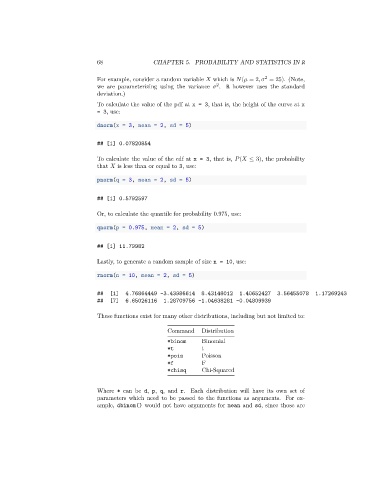
                                 These functions exist for many other distributions, including but not limited to:

                                                        Command     Distribution
                                                        *binom      Binomial
                                                        *t          t
                                                        *pois       Poisson
                                                        *f          F
                                                        *chisq      Chi-Squared


                                 Where * can be d, p, q, and r. Each distribution will have its own set of
                                 parameters which need to be passed to the functions as arguments. For ex-
                                 ample, dbinom() would not have arguments for mean and sd, since those are

