


Page 74 - Applied Statistics with R
P. 74
74                 CHAPTER 5. PROBABILITY AND STATISTICS IN R


                                 x_bar = mean(x)
                                 s_x   = sd(x)
                                 y_bar = mean(y)
                                 s_y   = sd(y)

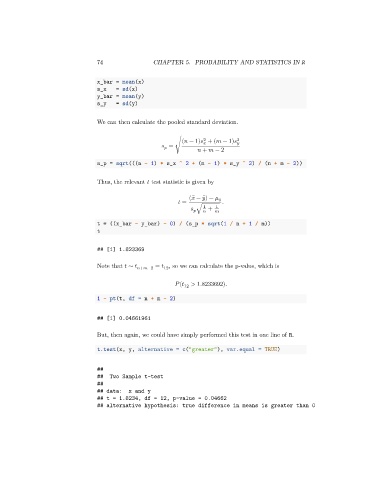
                                 We can then calculate the pooled standard deviation.


                                                                    2
                                                             (   − 1)   + (   − 1)   2

                                                         =  √        +    − 2

                                 s_p = sqrt(((n - 1) * s_x ^ 2 + (m - 1) * s_y ^ 2) / (n + m - 2))


                                 Thus, the relevant    test statistic is given by


                                                                ( ̄ − ̄) −
                                                               =         0 .
                                                                        1
                                                                    1
                                                                   √ +


                                 t = ((x_bar - y_bar) - 0) / (s_p * sqrt(1 / n + 1 / m))
                                 t
                                 ## [1] 1.823369

                                 Note that    ∼      +  −2  =    , so we can calculate the p-value, which is
                                                       12

                                                             (   12  > 1.8233692).

                                 1 - pt(t, df = n + m - 2)


                                 ## [1] 0.04661961

                                 But, then again, we could have simply performed this test in one line of R.

                                 t.test(x, y, alternative = c("greater"), var.equal = TRUE)


                                 ##
                                 ##  Two Sample t-test
                                 ##
                                 ## data:   x and y
                                 ## t = 1.8234, df = 12, p-value = 0.04662
                                 ## alternative hypothesis: true difference in means is greater than 0

