


Page 72 - Applied Statistics with R
P. 72
72                 CHAPTER 5. PROBABILITY AND STATISTICS IN R


                                    • The p-value of the test.
                                    • The confidence interval which corresponds to the test.
                                    • An estimate of   .

                                 Since the test was one-sided, R returned a one-sided confidence interval. If
                                 instead we wanted a two-sided interval for the mean weight of boxes of Captain
                                 Crisp cereal we could modify our code.

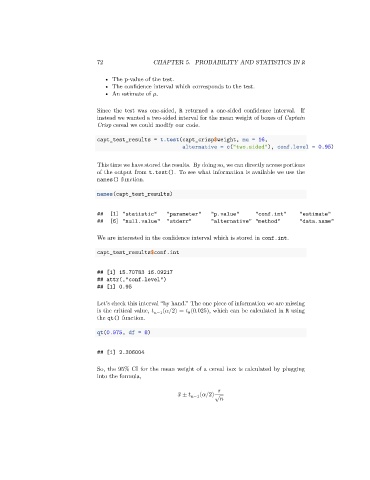
                                 capt_test_results = t.test(capt_crisp$weight, mu = 16,
                                                             alternative = c("two.sided"), conf.level = 0.95)

                                 This time we have stored the results. By doing so, we can directly access portions
                                 of the output from t.test(). To see what information is available we use the
                                 names() function.

                                 names(capt_test_results)


                                 ##  [1] "statistic"    "parameter"    "p.value"     "conf.int"     "estimate"
                                 ##  [6] "null.value"   "stderr"       "alternative" "method"       "data.name"

                                 We are interested in the confidence interval which is stored in conf.int.

                                 capt_test_results$conf.int


                                 ## [1] 15.70783 16.09217
                                 ## attr(,"conf.level")
                                 ## [1] 0.95


                                 Let’s check this interval “by hand.” The one piece of information we are missing
                                 is the critical value,      −1 (  /2) =    (0.025), which can be calculated in R using
                                                               8
                                 the qt() function.
                                 qt(0.975, df = 8)


                                 ## [1] 2.306004


                                 So, the 95% CI for the mean weight of a cereal box is calculated by plugging
                                 into the formula,


                                                             ̄    ±      −1 (  /2)√


