


Page 76 - Applied Statistics with R
P. 76
76                 CHAPTER 5. PROBABILITY AND STATISTICS IN R


                                 ##  Two Sample t-test
                                 ##
                                 ## data:   values by group
                                 ## t = 1.8234, df = 12, p-value = 0.04662
                                 ## alternative hypothesis: true difference in means between group A and group B is greater than 0
                                 ## 95 percent confidence interval:
                                 ##  0.1802451        Inf
                                 ## sample estimates:
                                 ## mean in group A mean in group B
                                 ##               80               72


                                 5.3    Simulation


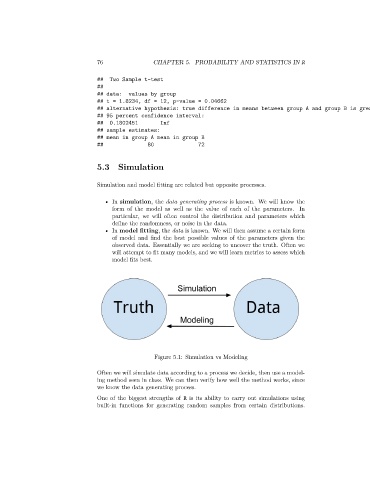
                                 Simulation and model fitting are related but opposite processes.

                                    • In simulation, the data generating process is known. We will know the
                                      form of the model as well as the value of each of the parameters. In
                                      particular, we will often control the distribution and parameters which
                                      define the randomness, or noise in the data.
                                    • In model fitting, the data is known. We will then assume a certain form
                                      of model and find the best possible values of the parameters given the
                                      observed data. Essentially we are seeking to uncover the truth. Often we
                                      will attempt to fit many models, and we will learn metrics to assess which
                                      model fits best.


                                                    Figure 5.1: Simulation vs Modeling

                                 Often we will simulate data according to a process we decide, then use a model-
                                 ing method seen in class. We can then verify how well the method works, since
                                 we know the data generating process.

                                 One of the biggest strengths of R is its ability to carry out simulations using
                                 built-in functions for generating random samples from certain distributions.

