


Page 97 - Applied Statistics with R
P. 97
7.2. LEAST SQUARES APPROACH                                        97


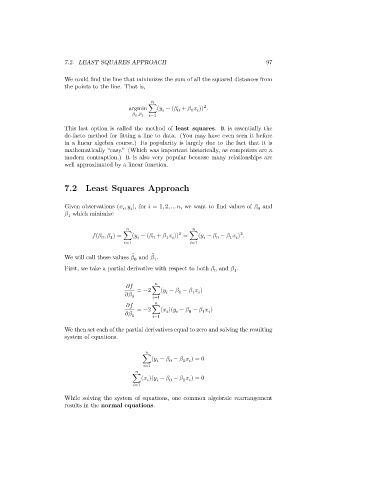
                      We could find the line that minimizes the sum of all the squared distances from
                      the points to the line. That is,


                                                                    2
                                            argmin ∑(   − (   +       )) .
                                                                1
                                                            0

                                                0 ,   1    =1
                      This last option is called the method of least squares. It is essentially the
                      de-facto method for fitting a line to data. (You may have even seen it before
                      in a linear algebra course.) Its popularity is largely due to the fact that it is
                      mathematically “easy.” (Which was important historically, as computers are a
                      modern contraption.) It is also very popular because many relationships are
                      well approximated by a linear function.


                      7.2 Least Squares Approach


                      Given observations (   ,    ), for    = 1, 2, …   , we want to find values of    and

                                                                                      0

                         which minimize
                        1

                                                                                 2
                                                            2
                                  (   ,    ) = ∑(   − (   +       )) = ∑(   −    −       ) .
                                                   0
                                                                         0
                                                                             1


                                      1
                                   0
                                                        1
                                            =1                    =1
                                                    ̂
                                              ̂
                      We will call these values    and    .
                                                    1
                                             0
                      First, we take a partial derivative with respect to both    and    .
                                                                        0
                                                                              1

                                              = −2 ∑(   −    −       )
                                                            0

                                                                 1
                                               0      =1

                                              = −2 ∑(   )(   −    −       )

                                                                    1
                                                               0

                                               1      =1
                      We then set each of the partial derivatives equal to zero and solving the resulting
                      system of equations.

                                                ∑(   −    −       ) = 0

                                                         0
                                                              1
                                                  =1

                                             ∑(   )(   −    −       ) = 0
                                                              1

                                                         0

                                               =1
                      While solving the system of equations, one common algebraic rearrangement
                      results in the normal equations.

