


Page 171 - First Aid for the USMLE Step 1 2020, Thirtieth edition [MedicalBooksVN.com]_Neat
P. 171
Microbiology ` microbiology—basic bacteriology Microbiology ` microbiology—basic bacteriology SEcTioN ii 127
Anaerobes Examples include Clostridium, Bacteroides, Anaerobes Can’t Breathe Fresh Air.
Fusobacterium, and Actinomyces israelii. They Anaerobes are normal flora in GI tract, typically
lack catalase and/or superoxide dismutase pathogenic elsewhere. AminO 2 glycosides are
and are thus susceptible to oxidative damage. ineffective against anaerobes because these
Generally foul smelling (short-chain fatty antibiotics require O 2 to enter into bacterial
acids), are difficult to culture, and produce gas cell.
in tissue (CO 2 and H 2 ).
Facultative anaerobes May use O 2 as a terminal electron acceptor to Streptococci, staphylococci, and enteric gram ⊝
generate ATP, but can also use fermentation bacteria.
and other O 2 -independent pathways.
Intracellular bacteria
Obligate intracellular Rickettsia, Chlamydia, Coxiella Stay inside (cells) when it is Really Chilly and
Rely on host ATP Cold
Facultative Salmonella, Neisseria, Brucella, Mycobacterium, Some Nasty Bugs May Live FacultativeLY
intracellular Listeria, Francisella, Legionella, Yersinia pestis
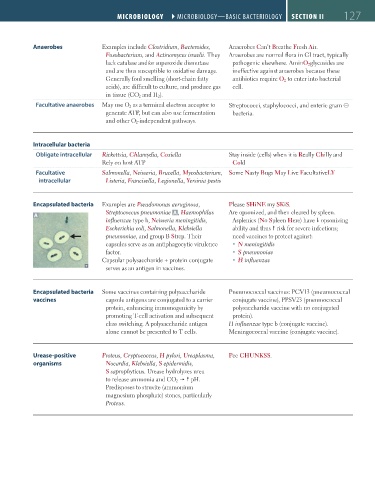
Encapsulated bacteria Examples are Pseudomonas aeruginosa, Please SHiNE my SKiS.
Streptococcus pneumoniae A , Haemophilus Are opsonized, and then cleared by spleen.
A
influenzae type b, Neisseria meningitidis, Asplenics (No Spleen Here) have opsonizing
Escherichia coli, Salmonella, Klebsiella ability and thus risk for severe infections;
pneumoniae, and group B Strep. Their need vaccines to protect against:
capsules serve as an antiphagocytic virulence N meningitidis
factor. S pneumoniae
Capsular polysaccharide + protein conjugate H influenzae
serves as an antigen in vaccines.
Encapsulated bacteria Some vaccines containing polysaccharide Pneumococcal vaccines: PCV13 (pneumococcal
vaccines capsule antigens are conjugated to a carrier conjugate vaccine), PPSV23 (pneumococcal
protein, enhancing immunogenicity by polysaccharide vaccine with no conjugated
promoting T-cell activation and subsequent protein).
class switching. A polysaccharide antigen H influenzae type b (conjugate vaccine).
alone cannot be presented to T cells. Meningococcal vaccine (conjugate vaccine).
Urease-positive Proteus, Cryptococcus, H pylori, Ureaplasma, Pee CHUNKSS.
organisms Nocardia, Klebsiella, S epidermidis,
S saprophyticus. Urease hydrolyzes urea
to release ammonia and CO 2 pH.
Predisposes to struvite (ammonium
magnesium phosphate) stones, particularly
Proteus.
FAS1_2019_03-Microbiology.indd 127 11/14/19 12:19 PM

