


Page 175 - First Aid for the USMLE Step 1 2020, Thirtieth edition [MedicalBooksVN.com]_Neat
P. 175
Microbiology  ` microbiology—basic bacteriology  Microbiology  ` microbiology—basic bacteriology      SEcTioN ii       131


                  Bacterial genetics (continued)
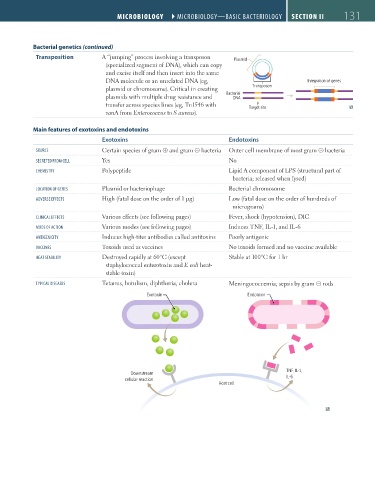
                   Transposition         A “jumping” process involving a transposon   Plasmid
                                          (specialized segment of DNA), which can copy
                                          and excise itself and then insert into the same
                                          DNA molecule or an unrelated DNA (eg,                             Integration of genes
                                          plasmid or chromosome). Critical in creating    Transposon
                                          plasmids with multiple drug resistance and   Bacterial
                                                                                    DNA
                                          transfer across species lines (eg, Tn1546 with   Target site
                                          vanA from Enterococcus to S aureus).


                  Main features of exotoxins and endotoxins
                                         Exotoxins                                Endotoxins
                   soUrce                Certain species of gram ⊕ and gram ⊝ bacteria  Outer cell membrane of most gram ⊝ bacteria
                   secreteD From cell    Yes                                      No
                   cHemistry             Polypeptide                              Lipid A component of LPS (structural part of
                                                                                   bacteria; released when lysed)
                   locatioN oF geNes     Plasmid or bacteriophage                 Bacterial chromosome
                   aDVerse eFFects       High (fatal dose on the order of 1 µg)   Low (fatal dose on the order of hundreds of
                                                                                   micrograms)

                   cliNical eFFects      Various effects (see following pages)    Fever, shock (hypotension), DIC
                   moDe oF actioN        Various modes (see following pages)      Induces TNF, IL-1, and IL-6
                   aNtigeNicity          Induces high-titer antibodies called antitoxins  Poorly antigenic
                   VacciNes              Toxoids used as vaccines                 No toxoids formed and no vaccine available
                   Heat stability        Destroyed rapidly at 60°C (except        Stable at 100°C for 1 hr
                                          staphylococcal enterotoxin and E coli heat-
                                          stable toxin)
                   tyPical Diseases      Tetanus, botulism, diphtheria, cholera   Meningococcemia; sepsis by gram ⊝ rods

                                                        Exotoxin                        Endotoxin


                                                                                                     TNF, IL-1,
                                                  Downstream
                                                cellular reaction                                    IL-6
                                                                               Host cell


          FAS1_2019_03-Microbiology.indd   131                                                                         11/14/19   12:20 PM

