


Page 174 - First Aid for the USMLE Step 1 2020, Thirtieth edition [MedicalBooksVN.com]_Neat
P. 174
130         SEcTioN ii    Microbiology  ` microbiology—basic bacteriology                                                                                   Microbiology  ` microbiology—basic bacteriology


               Bacterial genetics
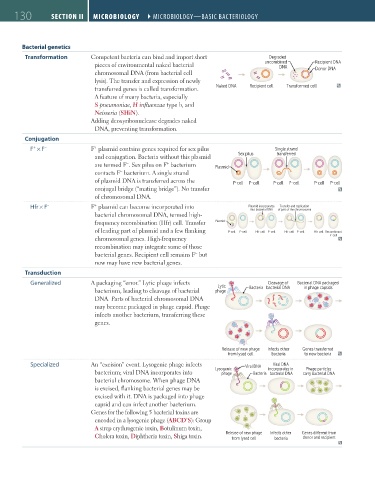
                Transformation       Competent bacteria can bind and import short              Degraded
                                       pieces of environmental naked bacterial                uncombined       Recipient DNA
                                                                                                   DNA
                                       chromosomal DNA (from bacterial cell                                    Donor DNA
                                       lysis). The transfer and expression of newly
                                       transferred genes is called transformation.   Naked DNA  Recipient cell  Transformed cell
                                       A feature of many bacteria, especially
                                       S pneumoniae, H influenzae type b, and
                                       Neisseria (SHiN).
                                     Adding deoxyribonuclease degrades naked
                                       DNA, preventing transformation.
                Conjugation
                 F  × F –            F  plasmid contains genes required for sex pilus            Single strand
                  +
                                      +
                                      and conjugation. Bacteria without this plasmid   Sex pilus  transferred
                                                              +
                                                 –
                                      are termed F . Sex pilus on F  bacterium   Plasmid
                                               −
                                      contacts F  bacterium. A single strand
                                       of plasmid DNA is transferred across the     F cell  F cell  F cell  F cell  F cell  F cell
                                                                                                       –
                                                                                                 +
                                                                                                                    +
                                                                                                               +
                                                                                    +
                                                                                          –
                                       conjugal bridge (“mating bridge”). No transfer
                                       of chromosomal DNA.
                                      +
                 Hfr × F –           F  plasmid can become incorporated into             Plasmid incorporates  Transfer and replication
                                                                                         into bacterial DNA  of part of the chromosome
                                      bacterial chromosomal DNA, termed high-
                                      frequency recombination (Hfr) cell. Transfer   Plasmid
                                      of leading part of plasmid and a few flanking   F +  cell  F –  cell  Hfr    cellF –  cell  Hfr    cell F –  cell  Hfr    cell Recombinant
                                      chromosomal genes. High-frequency                                            F –  cell
                                      recombination may integrate some of those
                                                                       –
                                      bacterial genes. Recipient cell remains F  but
                                       now may have new bacterial genes.
                Transduction
                 Generalized         A packaging “error.” Lytic phage infects                  Cleavage of   Bacterial DNA packaged
                                                                               Lytic
                                       bacterium, leading to cleavage of bacterial   phage  Bacteria bacterial DNA  in phage capsids
                                       DNA. Parts of bacterial chromosomal DNA
                                       may become packaged in phage capsid. Phage
                                       infects another bacterium, transferring these
                                       genes.


                                                                                Release of new phage  Infects other  Genes transferred
                                                                                  from lysed cell  bacteria  to new bacteria
                 Specialized         An “excision” event. Lysogenic phage infects       Viral DNA  Viral DNA
                                                                                               incorporates in
                                                                                                            Phage particles
                                       bacterium; viral DNA incorporates into   Lysogenic  Bacteria bacterial DNA  carry bacterial DNA
                                                                                phage
                                       bacterial chromosome. When phage DNA
                                       is excised, flanking bacterial genes may be
                                       excised with it. DNA is packaged into phage
                                       capsid and can infect another bacterium.
                                     Genes for the following 5 bacterial toxins are
                                       encoded in a lysogenic phage (ABCD’S): Group
                                       A strep erythrogenic toxin, Botulinum toxin,
                                       Cholera toxin, Diphtheria toxin, Shiga toxin.  Release of new phage  Infects other   Genes di erent from
                                                                                                          donor and recipient
                                                                                   from lysed cell
                                                                                                 bacteria


          FAS1_2019_03-Microbiology.indd   130                                                                         11/14/19   12:20 PM

