


Page 196 - First Aid for the USMLE Step 1 2020, Thirtieth edition [MedicalBooksVN.com]_Neat
P. 196
152 SEcTioN ii Microbiology ` microbiology—mycology Microbiology ` microbiology—mycology
Cutaneous mycoses
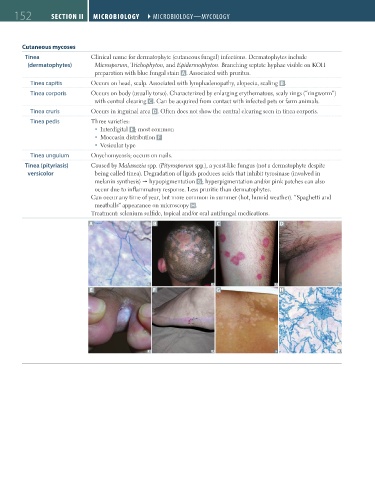
Tinea Clinical name for dermatophyte (cutaneous fungal) infections. Dermatophytes include
(dermatophytes) Microsporum, Trichophyton, and Epidermophyton. Branching septate hyphae visible on KOH
preparation with blue fungal stain A . Associated with pruritus.
Tinea capitis Occurs on head, scalp. Associated with lymphadenopathy, alopecia, scaling B .
Tinea corporis Occurs on body (usually torso). Characterized by enlarging erythematous, scaly rings (“ringworm”)
with central clearing C . Can be acquired from contact with infected pets or farm animals.
Tinea cruris Occurs in inguinal area D. Often does not show the central clearing seen in tinea corporis.
Tinea pedis Three varieties:
Interdigital E ; most common
Moccasin distribution F
Vesicular type
Tinea unguium Onychomycosis; occurs on nails.
Tinea (pityriasis) Caused by Malassezia spp. (Pityrosporum spp.), a yeast-like fungus (not a dermatophyte despite
versicolor being called tinea). Degradation of lipids produces acids that inhibit tyrosinase (involved in
melanin synthesis) hypopigmentation G; hyperpigmentation and/or pink patches can also
occur due to inflammatory response. Less pruritic than dermatophytes.
Can occur any time of year, but more common in summer (hot, humid weather). “Spaghetti and
meatballs” appearance on microscopy H.
Treatment: selenium sulfide, topical and/or oral antifungal medications.
A B C D
E F G H
FAS1_2019_03-Microbiology.indd 152 11/14/19 12:21 PM

