


Page 225 - First Aid for the USMLE Step 1 2020, Thirtieth edition [MedicalBooksVN.com]_Neat
P. 225
Microbiology  ` microbiology—systems                    Microbiology  ` microbiology—systems          SEcTioN ii       181


                  Urinary tract          Cystitis presents with dysuria, frequency, urgency, suprapubic pain, and WBCs (but not WBC
                  infections              casts) in urine. Primarily caused by ascension of microbes from urethra to bladder. Ascension to
                                          kidney results in pyelonephritis, which presents with fever, chills, flank pain, costovertebral angle
                                          tenderness, hematuria, and WBC casts.
                                         Ten times more common in women (shorter urethras colonized by fecal flora).
                                         Risk factors: obstruction (eg, kidney stones, enlarged prostate), kidney surgery, catheterization,
                                          congenital GU malformation (eg, vesicoureteral reflux), diabetes, pregnancy.
                   sPecies               FeatUres                                 commeNts
                   Escherichia coli      Leading cause of UTI. Colonies show strong   Diagnostic markers:
                                          pink lactose-fermentation on MacConkey    ⊕ Leukocyte esterase = evidence of WBC
                                          agar.                                       activity.

                   Staphylococcus        2nd leading cause of UTI in sexually active   ⊕ Nitrite test = reduction of urinary nitrates
                    saprophyticus         women.                                      by gram ⊝ bacterial species (eg, E coli).
                                                                                    ⊕  Urease test = urease-producing bugs (eg,
                   Klebsiella pneumoniae  3rd leading cause of UTI. Large mucoid capsule   S saprophyticus, Proteus, Klebsiella).
                                          and viscous colonies.
                   Serratia marcescens   Some strains produce a red pigment; often
                                          nosocomial and drug resistant.
                   Enterococcus          Often nosocomial and drug resistant.

                   Proteus mirabilis     Motility causes “swarming” on agar; associated
                                          with struvite stones.
                   Pseudomonas           Blue-green pigment and fruity odor; usually
                    aeruginosa            nosocomial and drug resistant.


                  Common vaginal infections
                                         Bacterial vaginosis         Trichomonas vaginitis      Candida vulvovaginitis
                   sigNs aND symPtoms    No inflammation            Inflammation (“strawberry   Inflammation
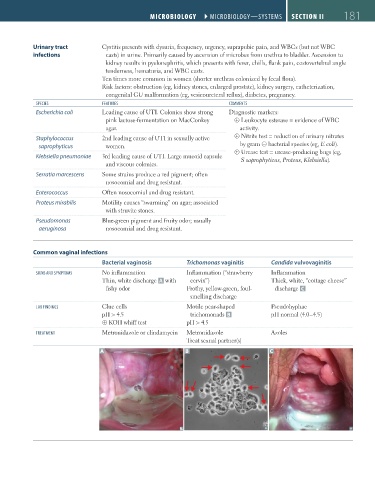
                                         Thin, white discharge  A  with   cervix”)              Thick, white, “cottage cheese”
                                          fishy odor                Frothy, yellow-green, foul-  discharge  C
                                                                      smelling discharge
                   lab FiNDiNgs          Clue cells                  Motile pear-shaped         Pseudohyphae
                                         pH > 4.5                     trichomonads  B           pH normal (4.0–4.5)
                                         ⊕ KOH whiff test            pH > 4.5
                   treatmeNt             Metronidazole or clindamycin  Metronidazole            Azoles
                                                                     Treat sexual partner(s)
                                        A                           B                           C


          FAS1_2019_03-Microbiology.indd   181                                                                         11/14/19   12:22 PM

