


Page 265 - First Aid for the USMLE Step 1 2020, Thirtieth edition [MedicalBooksVN.com]_Neat
P. 265
Pathology ` PATHOLOGY—neOPLASIA Pathology ` PATHOLOGY—neOPLASIA SECtIoN II 221
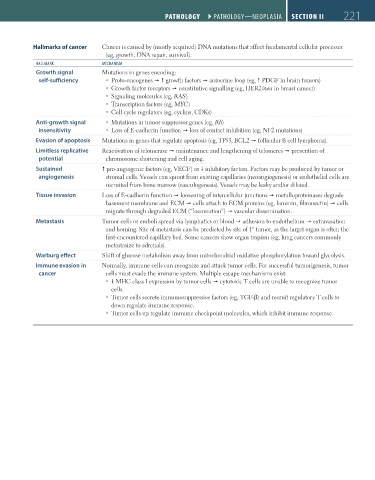
Hallmarks of cancer Cancer is caused by (mostly acquired) DNA mutations that affect fundamental cellular processes
(eg, growth, DNA repair, survival).
HALLMArK MeCHAnISM
Growth signal Mutations in genes encoding:
self-sufficiency Proto-oncogenes growth factors autocrine loop (eg, PDGF in brain tumors)
Growth factor receptors constitutive signalling (eg, HER2/neu in breast cancer)
Signaling molecules (eg, RAS)
Transcription factors (eg, MYC)
Cell cycle regulators (eg, cyclins, CDKs)
Anti-growth signal Mutations in tumor suppressor genes (eg, Rb)
insensitivity Loss of E-cadherin function loss of contact inhibition (eg, NF2 mutations)
Evasion of apoptosis Mutations in genes that regulate apoptosis (eg, TP53, BCL2 follicular B cell lymphoma).
Limitless replicative Reactivation of telomerase maintenance and lengthening of telomeres prevention of
potential chromosome shortening and cell aging.
Sustained pro-angiogenic factors (eg, VEGF) or inhibitory factors. Factors may be produced by tumor or
angiogenesis stromal cells. Vessels can sprout from existing capillaries (neoangiogenesis) or endothelial cells are
recruited from bone marrow (vasculogenesis). Vessels may be leaky and/or dilated.
Tissue invasion Loss of E-cadherin function loosening of intercellular junctions metalloproteinases degrade
basement membrane and ECM cells attach to ECM proteins (eg, laminin, fibronectin) cells
migrate through degraded ECM (“locomotion”) vascular dissemination.
Metastasis Tumor cells or emboli spread via lymphatics or blood adhesion to endothelium extravasation
and homing. Site of metastasis can be predicted by site of 1° tumor, as the target organ is often the
first-encountered capillary bed. Some cancers show organ tropism (eg, lung cancers commonly
metastasize to adrenals).
Warburg effect Shift of glucose metabolism away from mitochondrial oxidative phosphorylation toward glycolysis.
Immune evasion in Normally, immune cells can recognize and attack tumor cells. For successful tumorigenesis, tumor
cancer cells must evade the immune system. Multiple escape mechanisms exist:
MHC class I expression by tumor cells cytotoxic T cells are unable to recognize tumor
cells.
Tumor cells secrete immunosuppressive factors (eg, TGF-β) and recruit regulatory T cells to
down regulate immune response.
Tumor cells up regulate immune checkpoint molecules, which inhibit immune response.
FAS1_2019_04-Pathol.indd 221 11/7/19 4:02 PM

