


Page 363 - First Aid for the USMLE Step 1 2020, Thirtieth edition [MedicalBooksVN.com]_Neat
P. 363
CARDIOvASCuLAR ``CARdIOvASCulAR—PHARMACOlOGY CARDIOvASCuLAR ``CARdIOvASCulAR—PHARMACOlOGY SECTION III 319
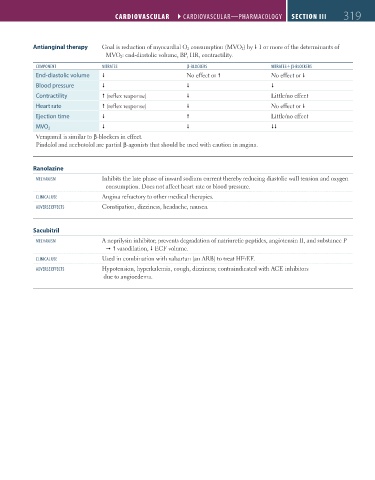
Antianginal therapy Goal is reduction of myocardial O 2 consumption (MVO 2 ) by 1 or more of the determinants of
MVO 2 : end-diastolic volume, BP, HR, contractility.
COMPONENT NITRATES β-blOCKERS NITRATES + β-blOCKERS
End-diastolic volume No effect or No effect or
Blood pressure
Contractility (reflex response) Little/no effect
Heart rate (reflex response) No effect or
Ejection time Little/no effect
MVO 2
Verapamil is similar to β-blockers in effect.
Pindolol and acebutolol are partial β-agonists that should be used with caution in angina.
Ranolazine
MECHANISM Inhibits the late phase of inward sodium current thereby reducing diastolic wall tension and oxygen
consumption. Does not affect heart rate or blood pressure.
ClINICAl uSE Angina refractory to other medical therapies.
AdvERSE EFFECTS Constipation, dizziness, headache, nausea.
Sacubitril
MECHANISM A neprilysin inhibitor; prevents degradation of natriuretic peptides, angiotensin II, and substance P
vasodilation, ECF volume.
ClINICAl uSE Used in combination with valsartan (an ARB) to treat HFrEF.
AdvERSE EFFECTS Hypotension, hyperkalemia, cough, dizziness; contraindicated with ACE inhibitors
due to angioedema.
FAS1_2019_07-Cardio.indd 319 11/7/19 4:24 PM

