


Page 412 - First Aid for the USMLE Step 1 2020, Thirtieth edition [MedicalBooksVN.com]_Neat
P. 412
368 seCtion iii Gastrointestinal ` gastrointestinal—anatomy Gastrointestinal ` gastrointestinal—anatomy
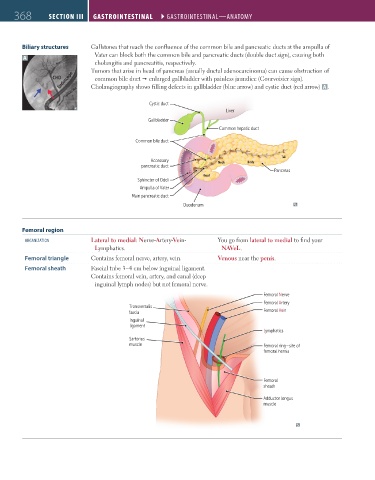
Biliary structures Gallstones that reach the confluence of the common bile and pancreatic ducts at the ampulla of
Vater can block both the common bile and pancreatic ducts (double duct sign), causing both
A
cholangitis and pancreatitis, respectively.
Tumors that arise in head of pancreas (usually ductal adenocarcinoma) can cause obstruction of
Endoscope Cholangiography shows filling defects in gallbladder (blue arrow) and cystic duct (red arrow) A .
CHD common bile duct enlarged gallbladder with painless jaundice (Courvoisier sign).
Pancreatic duct
Cystic duct
Liver
Gallbladder
Common hepatic duct
Common bile duct
Tail
Accessory Neck Body
pancreatic duct
Pancreas
Head
Sphincter of Oddi
Ampulla of Vater
Main pancreatic duct
Duodenum
Femoral region
organiZation Lateral to medial: Nerve-Artery-Vein- You go from lateral to medial to find your
Lymphatics. NAVeL.
Femoral triangle Contains femoral nerve, artery, vein. Venous near the penis.
Femoral sheath Fascial tube 3–4 cm below inguinal ligament.
Contains femoral vein, artery, and canal (deep
inguinal lymph nodes) but not femoral nerve.
Femoral Nerve
Femoral Artery
Transversalis
fascia Femoral Vein
Inguinal
ligament
Lymphatics
Sartorius
muscle Femoral ring—site of
femoral hernia
Femoral
sheath
Adductor longus
muscle
FAS1_2019_09-Gastrointestinal.indd 368 11/7/19 4:42 PM

