


Page 414 - First Aid for the USMLE Step 1 2020, Thirtieth edition [MedicalBooksVN.com]_Neat
P. 414
370        seCtion iii    Gastrointestinal  ` gastrointestinal—anatomy                                                                                      Gastrointestinal  ` gastrointestinal—PHysiology


               Hernias               Protrusion of peritoneum through an opening, usually at a site of weakness. Contents may be at
                                       risk for incarceration (not reducible back into abdomen/pelvis) and strangulation (ischemia and
                                       necrosis). Complicated hernias can present with tenderness, erythema, fever.
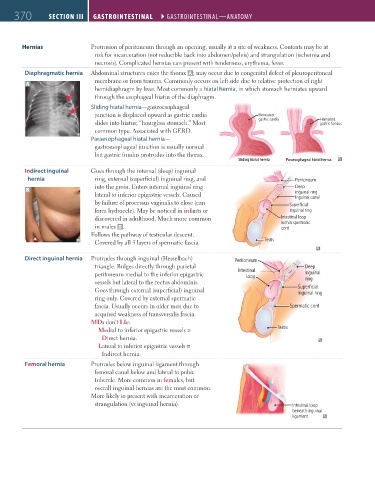
                Diaphragmatic hernia  Abdominal structures enter the thorax  A ; may occur due to congenital defect of pleuroperitoneal
                                       membrane or from trauma. Commonly occurs on left side due to relative protection of right
                A
                                       hemidiaphragm by liver. Most commonly a hiatal hernia, in which stomach herniates upward
                                       through the esophageal hiatus of the diaphragm.
                                     Sliding hiatal hernia—gastroesophageal
                                       junction is displaced upward as gastric cardia       Herniated
                                       slides into hiatus; “hourglass stomach.” Most        gastric cardia      Herniated
                                                                                                                gastric fundus
                                       common type. Associated with GERD.
                                     Paraesophageal hiatal hernia—
                                       gastroesophageal junction is usually normal
                                       but gastric fundus protrudes into the thorax.
                                                                                     Sliding hiatal hernia  Paraesophageal hiatal hernia
                Indirect inguinal    Goes through the internal (deep) inguinal
                 hernia               ring, external (superficial) inguinal ring, and                   Peritoneum
                B                     into the groin. Enters internal inguinal ring                     Deep
                                      lateral to inferior epigastric vessels. Caused                    inguinal ring
                                                                                                        Inguinal canal
                                      by failure of processus vaginalis to close (can                 Superficial
                                      form hydrocele). May be noticed in infants or                   inguinal ring
                                      discovered in adulthood. Much more common                    Intestinal loop
                                      in males  B .                                                within spermatic
                                                                                                   cord
                                     Follows the pathway of testicular descent.
                                      Covered by all 3 layers of spermatic fascia.            Testis

                Direct inguinal hernia  Protrudes through inguinal (Hesselbach)     Peritoneum
                                      triangle. Bulges directly through parietal                           Deep
                                      peritoneum medial to the inferior epigastric   Intestinal            inguinal
                                                                                        loop
                                      vessels but lateral to the rectus abdominis.                         ring
                                      Goes through external (superficial) inguinal                       Superficial
                                                                                                         inguinal ring
                                      ring only. Covered by external spermatic
                                      fascia. Usually occurs in older men due to                      Spermatic cord
                                      acquired weakness of transversalis fascia.
                                     MDs don’t LIe:
                                        Medial to inferior epigastric vessels =                   Testis
                                         Direct hernia.
                                        Lateral to inferior epigastric vessels =
                                         Indirect hernia.
                Femoral hernia       Protrudes below inguinal ligament through
                                      femoral canal below and lateral to pubic
                                      tubercle. More common in females, but
                                      overall inguinal hernias are the most common.
                                     More likely to present with incarceration or
                                      strangulation (vs inguinal hernia).                              Intestinal loop
                                                                                                       beneath inguinal
                                                                                                       ligament


          FAS1_2019_09-Gastrointestinal.indd   370                                                                      11/7/19   4:42 PM

