


Page 660 - First Aid for the USMLE Step 1 2020, Thirtieth edition [MedicalBooksVN.com]_Neat
P. 660
616 SectioN iii RepRoductive ` REPRODUCTIVE—EmbRyOlOgy RepRoductive ` REPRODUCTIVE—EmbRyOlOgy
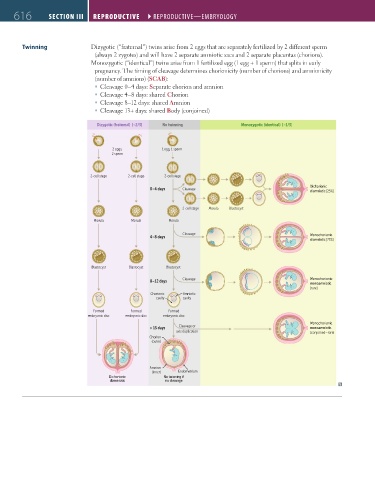
Twinning Dizygotic (“fraternal”) twins arise from 2 eggs that are separately fertilized by 2 different sperm
(always 2 zygotes) and will have 2 separate amniotic sacs and 2 separate placentas (chorions).
Monozygotic (“identical”) twins arise from 1 fertilized egg (1 egg + 1 sperm) that splits in early
pregnancy. The timing of cleavage determines chorionicity (number of chorions) and amnionicity
(number of amnions) (SCAB):
Cleavage 0–4 days: Separate chorion and amnion
Cleavage 4–8 days: shared Chorion
Cleavage 8–12 days: shared Amnion
Cleavage 13+ days: shared Body (conjoined)
Dizygotic (fraternal) [~2/3] No twinning Monozygotic (identical) [~1/3]
2 eggs, 1 egg, 1 sperm
2 sperm
2-cell stage 2-cell stage 2-cell stage
Dichorionic
0–4 days Cleavage
diamniotic [25%]
2-cell stage Morula Blastocyst
Morula Morula Morula
Cleavage Monochorionic
4–8 days
diamniotic [75%]
Blastocyst Blastocyst Blastocyst
8–12 days Cleavage Monochorionic
monoamniotic
[rare]
Chorionic Amniotic
cavity cavity
Formed Formed Formed
embryonic disc embryonic disc embryonic disc
Monochorionic
> 13 days Cleavage or monoamniotic
axis duplication [conjoined—rare]
Chorion
(outer)
Amnion
(inner) Endometrium
Dichorionic No twinning if
diamniotic no cleavage
FAS1_2019_15-Repro.indd 616 11/7/19 5:52 PM

