


Page 139 - The City and Guilds Textbook: Plumbing Book 1 for the Level 3 Apprenticeship (9189), Level 2 Technical Certificate (8202) and Level 2 Diploma (6035)
P. 139
Chapter 2 Common processes and techniques


                to copper tube installation, fabrication and planning, savings can be made on
                labour costs and material usage. A big part of installing copper tubes is the
                planning of pipework routes, ensuring that surface-mounted pipework, once
                installed, looks neat, and is well clipped, unobtrusive and performs to the design
                criteria.
                The correct clipping of copper tube is essential. It prevents excessive noise and
                fittings failure from vibration, movement and water hammer, and can assist
                in preventing accidental or intentional damage of the pipework. There are
                many different types of pipe clip available for copper tubes and each one has a
                specific use.

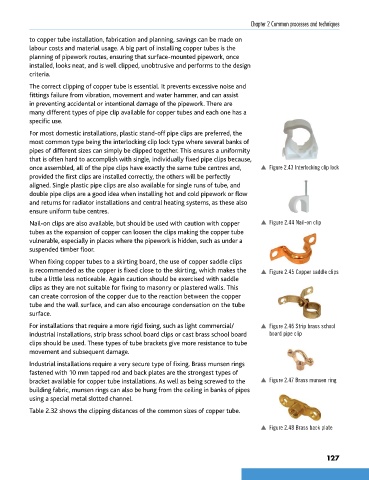
                For most domestic installations, plastic stand-off pipe clips are preferred, the
                most common type being the interlocking clip lock type where several banks of
                pipes of different sizes can simply be clipped together. This ensures a uniformity
                that is often hard to accomplish with single, individually fixed pipe clips because,
                once assembled, all of the pipe clips have exactly the same tube centres and,   p  Figure 2.43 Interlocking clip lock
                provided the first clips are installed correctly, the others will be perfectly
                aligned. Single plastic pipe clips are also available for single runs of tube, and
                double pipe clips are a good idea when installing hot and cold pipework or flow
                and returns for radiator installations and central heating systems, as these also
                ensure uniform tube centres.

                Nail-on clips are also available, but should be used with caution with copper   p  Figure 2.44 Nail-on clip
                tubes as the expansion of copper can loosen the clips making the copper tube
                vulnerable, especially in places where the pipework is hidden, such as under a
                suspended timber floor.

                When fixing copper tubes to a skirting board, the use of copper saddle clips
                is recommended as the copper is fixed close to the skirting, which makes the   p  Figure 2.45 Copper saddle clips
                tube a little less noticeable. Again caution should be exercised with saddle
                clips as they are not suitable for fixing to masonry or plastered walls. This
                can create corrosion of the copper due to the reaction between the copper
                tube and the wall surface, and can also encourage condensation on the tube
                surface.
                For installations that require a more rigid fixing, such as light commercial/  p  Figure 2.46 Strip brass school
                industrial installations, strip brass school board clips or cast brass school board   board pipe clip
                clips should be used. These types of tube brackets give more resistance to tube
                movement and subsequent damage.
                Industrial installations require a very secure type of fixing. Brass munsen rings
                fastened with 10 mm tapped rod and back plates are the strongest types of
                bracket available for copper tube installations. As well as being screwed to the   p  Figure 2.47 Brass munsen ring
                building fabric, munsen rings can also be hung from the ceiling in banks of pipes
                using a special metal slotted channel.

                Table 2.32 shows the clipping distances of the common sizes of copper tube.

                                                                                           p  Figure 2.48 Brass back plate


                                                                                                                127


        9781510416482.indb   127                                                                                    29/03/19   8:54 PM

