


Page 143 - The City and Guilds Textbook: Plumbing Book 1 for the Level 3 Apprenticeship (9189), Level 2 Technical Certificate (8202) and Level 2 Diploma (6035)
P. 143
Chapter 2 Common processes and techniques
Screw length and gauge
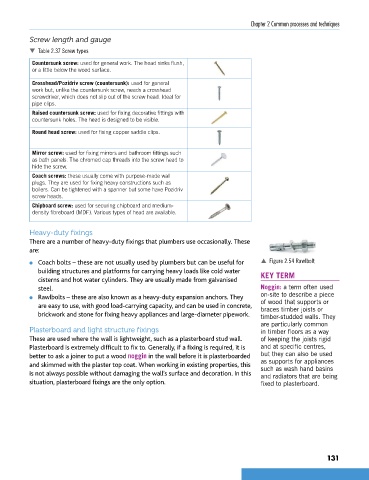
Table 2.37 Screw types
Countersunk screw: used for general work. The head sinks flush,
or a little below the wood surface.
Crosshead/Pozidriv screw (countersunk): used for general
work but, unlike the countersunk screw, needs a crosshead
screwdriver, which does not slip out of the screw head. Ideal for
pipe clips.
Raised countersunk screw: used for fixing decorative fittings with
countersunk holes. The head is designed to be visible.
Round head screw: used for fixing copper saddle clips.
Mirror screw: used for fixing mirrors and bathroom fittings such
as bath panels. The chromed cap threads into the screw head to
hide the screw.
Coach screws: these usually come with purpose-made wall
plugs. They are used for fixing heavy constructions such as
boilers. Can be tightened with a spanner but some have Pozidriv
screw heads.
Chipboard screw: used for securing chipboard and medium-
density fibreboard (MDF). Various types of head are available.
Heavy-duty fixings
There are a number of heavy-duty fixings that plumbers use occasionally. These
are:
● Coach bolts – these are not usually used by plumbers but can be useful for p Figure 2.54 Rawlbolt
building structures and platforms for carrying heavy loads like cold water KEY TERM
cisterns and hot water cylinders. They are usually made from galvanised
steel. Noggin: a term often used
● Rawlbolts – these are also known as a heavy-duty expansion anchors. They on-site to describe a piece
are easy to use, with good load-carrying capacity, and can be used in concrete, of wood that supports or
braces timber joists or
brickwork and stone for fixing heavy appliances and large-diameter pipework. timber-studded walls. They
are particularly common
Plasterboard and light structure fixings in timber floors as a way
These are used where the wall is lightweight, such as a plasterboard stud wall. of keeping the joists rigid
Plasterboard is extremely difficult to fix to. Generally, if a fixing is required, it is and at specific centres,
better to ask a joiner to put a wood noggin in the wall before it is plasterboarded but they can also be used
and skimmed with the plaster top coat. When working in existing properties, this as supports for appliances
such as wash hand basins
is not always possible without damaging the wall’s surface and decoration. In this and radiators that are being
situation, plasterboard fixings are the only option. fixed to plasterboard.
131
9781510416482.indb 131 29/03/19 8:54 PM

