


Page 251 - The City and Guilds Textbook: Plumbing Book 1 for the Level 3 Apprenticeship (9189), Level 2 Technical Certificate (8202) and Level 2 Diploma (6035)
P. 251
Chapter 5 Cold water systems

                Water moves constantly in what is scientifically called the hydrological cycle.
                We know it by its more common name: the rainwater cycle.

                Simply explained, the rainwater cycle is a natural process where water is
                continually exchanged between the atmosphere, surface water, groundwater,
                soil water and plants. It can be divided into three main transfer processes:

                1  evaporation from oceans and other water bodies into the air
                2  transpiration from land plants and animals into the air
                3  precipitation from water vapour condensing from the air and falling back to
                   Earth or into the ocean.


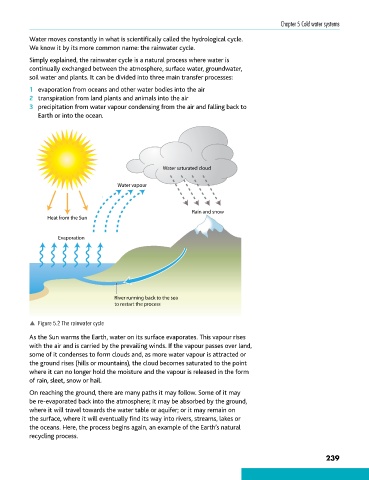
                                                           Water saturated cloud

                                            Water vapour


                                                                     Rain and snow
                      Heat from the Sun


                         Evaporation


                                           River running back to the sea
                                           to restart the process


                p  Figure 5.2 The rainwater cycle

                As the Sun warms the Earth, water on its surface evaporates. This vapour rises
                with the air and is carried by the prevailing winds. If the vapour passes over land,
                some of it condenses to form clouds and, as more water vapour is attracted or
                the ground rises (hills or mountains), the cloud becomes saturated to the point
                where it can no longer hold the moisture and the vapour is released in the form
                of rain, sleet, snow or hail.
                On reaching the ground, there are many paths it may follow. Some of it may
                be re-evaporated back into the atmosphere; it may be absorbed by the ground,
                where it will travel towards the water table or aquifer; or it may remain on
                the surface, where it will eventually find its way into rivers, streams, lakes or
                the oceans. Here, the process begins again, an example of the Earth’s natural
                recycling process.


                                                                                                                239


        9781510416482.indb   239                                                                                    29/03/19   8:56 PM

