


Page 246 - The City and Guilds Textbook: Plumbing Book 1 for the Level 3 Apprenticeship (9189), Level 2 Technical Certificate (8202) and Level 2 Diploma (6035)
P. 246
The City & Guilds Textbook: Plumbing Book 1
For example, providing a method and system of working for employees
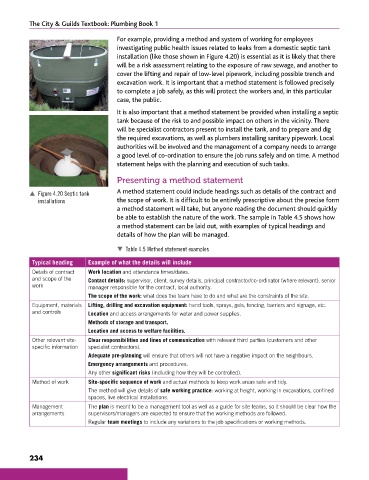
investigating public health issues related to leaks from a domestic septic tank
installation (like those shown in Figure 4.20) is essential as it is likely that there
will be a risk assessment relating to the exposure of raw sewage, and another to
cover the lifting and repair of low-level pipework, including possible trench and
excavation work. It is important that a method statement is followed precisely
to complete a job safely, as this will protect the workers and, in this particular
case, the public.
It is also important that a method statement be provided when installing a septic
tank because of the risk to and possible impact on others in the vicinity. There
will be specialist contractors present to install the tank, and to prepare and dig
the required excavations, as well as plumbers installing sanitary pipework. Local
authorities will be involved and the management of a company needs to arrange
a good level of co-ordination to ensure the job runs safely and on time. A method
statement helps with the planning and execution of such tasks.
Presenting a method statement
p Figure 4.20 Septic tank A method statement could include headings such as details of the contract and
installations the scope of work. It is difficult to be entirely prescriptive about the precise form
a method statement will take, but anyone reading the document should quickly
be able to establish the nature of the work. The sample in Table 4.5 shows how
a method statement can be laid out, with examples of typical headings and
details of how the plan will be managed.
able 4.5 Method statement examples
T
Typical heading Example of what the details will include
Details of contract Work location and attendance times/dates.
and scope of the Contact details: supervisor, client, survey details, principal contractor/co-ordinator (where relevant), senior
work manager responsible for the contract, local authority.
The scope of the work: what does the team have to do and what are the constraints of the site.
Equipment, materials Lifting, drilling and excavation equipment: hand tools, sprays, gels, fencing, barriers and signage, etc.
and controls Location and access arrangements for water and power supplies.
Methods of storage and transport.
Location and access to welfare facilities.
Other relevant site- Clear responsibilities and lines of communication with relevant third parties (customers and other
specific information specialist contractors).
Adequate pre-planning will ensure that others will not have a negative impact on the neighbours.
Emergency arrangements and procedures.
Any other significant risks (including how they will be controlled).
Method of work Site-specific sequence of work and actual methods to keep work areas safe and tidy.
The method will give details of safe working practice: working at height, working in excavations, confined
spaces, live electrical installations.
Management The plan is meant to be a management tool as well as a guide for site teams, so it should be clear how the
arrangements supervisors/managers are expected to ensure that the working methods are followed.
Regular team meetings to include any variations to the job specifications or working methods.
234
9781510416482.indb 234 29/03/19 8:56 PM

