


Page 287 - The City and Guilds Textbook: Plumbing Book 1 for the Level 3 Apprenticeship (9189), Level 2 Technical Certificate (8202) and Level 2 Diploma (6035)
P. 287
Chapter 5 Cold water systems

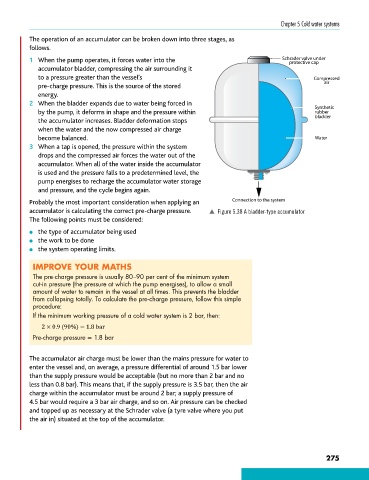
                The operation of an accumulator can be broken down into three stages, as
                follows.

                1  When the pump operates, it forces water into the                               Schrader valve under
                                                                                                    protective cap
                   accumulator bladder, compressing the air surrounding it
                   to a pressure greater than the vessel’s                                                  Compressed
                   pre-charge pressure. This is the source of the stored                                       air
                   energy.
                2  When the bladder expands due to water being forced in
                                                                                                            Synthetic
                   by the pump, it deforms in shape and the pressure within                                 rubber
                                                                                                            bladder
                   the accumulator increases. Bladder deformation stops
                   when the water and the now compressed air charge
                   become balanced.                                                                         Water
                3  When a tap is opened, the pressure within the system
                   drops and the compressed air forces the water out of the
                   accumulator. When all of the water inside the accumulator
                   is used and the pressure falls to a predetermined level, the
                   pump energises to recharge the accumulator water storage
                   and pressure, and the cycle begins again.

                Probably the most important consideration when applying an        Connection to the system
                accumulator is calculating the correct pre-charge pressure.   p  Figure 5.38 A bladder-type accumulator
                The following points must be considered:
                ●  the type of accumulator being used
                ●  the work to be done
                ●  the system operating limits.

                 IMPROVE YOUR MATHS
                 The pre-charge pressure is usually 80–90 per cent of the minimum system
                 cut-in pressure (the pressure at which the pump energises), to allow a small
                 amount of water to remain in the vessel at all times. This prevents the bladder
                 from collapsing totally. To calculate the pre-charge pressure, follow this simple
                 procedure:
                 If the minimum working pressure of a cold water system is 2 bar, then:

                    2 × 0.9 (90%) = 1.8 bar
                 Pre-charge pressure = 1.8 bar


                The accumulator air charge must be lower than the mains pressure for water to
                enter the vessel and, on average, a pressure differential of around 1.5 bar lower
                than the supply pressure would be acceptable (but no more than 2 bar and no
                less than 0.8 bar). This means that, if the supply pressure is 3.5 bar, then the air
                charge within the accumulator must be around 2 bar; a supply pressure of
                4.5 bar would require a 3 bar air charge, and so on. Air pressure can be checked
                and topped up as necessary at the Schrader valve (a tyre valve where you put
                the air in) situated at the top of the accumulator.


                                                                                                                275


        9781510416482.indb   275                                                                                    29/03/19   8:57 PM

