


Page 292 - The City and Guilds Textbook: Plumbing Book 1 for the Level 3 Apprenticeship (9189), Level 2 Technical Certificate (8202) and Level 2 Diploma (6035)
P. 292
The City & Guilds Textbook: Plumbing Book 1

                                            Inlet requirements for domestic cisterns

                                            The inlet requirements state that all cisterns will be fitted with an adjustable
                                            water inlet control device. These devices are usually float-operated valves that
                                                          must conform to BS 1212. The British Standard defines four
                                                 High     types of float-operated valve that are suitable for use in cold
                                                 pressure
                                                 orifice  water cisterns:

                          Water outlet                    ●   Part 1 – Portsmouth type (permitted only with a backflow
                                                             prevention device)
                                                          ●  Part 2 – brass diaphragm type
                                                          ●  Part 3 – plastic diaphragm type
                                                Water inlet
                                                          ●   Part 4 – diaphragm equilibrium type (used only on WC
                                                Union
                                                             cisterns).
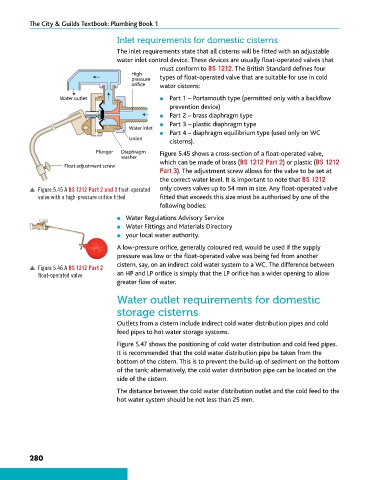
                                     Plunger  Diaphragm   Figure 5.45 shows a cross-section of a float-operated valve,
                                              washer
                                                          which can be made of brass (BS 1212 Part 2) or plastic (BS 1212
                           Float adjustment screw
                                                          Part 3). The adjustment screw allows for the valve to be set at
                                                          the correct water level. It is important to note that BS 1212
                p  Figure 5.45 A BS 1212 Part 2 and 3 float-operated   only covers valves up to 54 mm in size. Any float-operated valve
                   valve with a high-pressure orifice fitted  fitted that exceeds this size must be authorised by one of the
                                                          following bodies:

                                            ●  Water Regulations Advisory Service
                                            ●  Water Fittings and Materials Directory
                                            ●  your local water authority.

                                            A low-pressure orifice, generally coloured red, would be used if the supply
                                            pressure was low or the float-operated valve was being fed from another
                                            cistern, say, on an indirect cold water system to a WC. The difference between
                p  Figure 5.46 A BS 1212 Part 2
                   float-operated valve     an HP and LP orifice is simply that the LP orifice has a wider opening to allow
                                            greater flow of water.

                                            Water outlet requirements for domestic
                                            storage cisterns

                                            Outlets from a cistern include indirect cold water distribution pipes and cold
                                            feed pipes to hot water storage systems.
                                            Figure 5.47 shows the positioning of cold water distribution and cold feed pipes.
                                            It is recommended that the cold water distribution pipe be taken from the
                                            bottom of the cistern. This is to prevent the build-up of sediment on the bottom
                                            of the tank; alternatively, the cold water distribution pipe can be located on the
                                            side of the cistern.

                                            The distance between the cold water distribution outlet and the cold feed to the
                                            hot water system should be not less than 25 mm.


                280


        9781510416482.indb   280                                                                                    29/03/19   8:57 PM

