


Page 290 - The City and Guilds Textbook: Plumbing Book 1 for the Level 3 Apprenticeship (9189), Level 2 Technical Certificate (8202) and Level 2 Diploma (6035)
P. 290
The City & Guilds Textbook: Plumbing Book 1

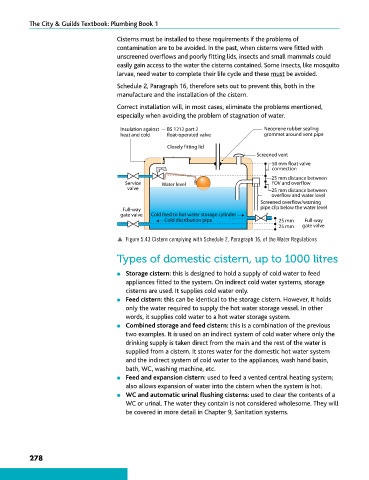
                                            Cisterns must be installed to these requirements if the problems of
                                            contamination are to be avoided. In the past, when cisterns were fitted with
                                            unscreened overflows and poorly fitting lids, insects and small mammals could
                                            easily gain access to the water the cisterns contained. Some insects, like mosquito
                                            larvae, need water to complete their life cycle and these must be avoided.
                                            Schedule 2, Paragraph 16, therefore sets out to prevent this, both in the
                                            manufacture and the installation of the cistern.
                                            Correct installation will, in most cases, eliminate the problems mentioned,
                                            especially when avoiding the problem of stagnation of water.

                                             Insulation against  BS 1212 part 2             Neoprene rubber sealing
                                             heat and cold  float-operated valve            grommet around vent pipe
                                                             Closely fitting lid
                                                                                         Screened vent
                                                                                              50 mm float valve
                                                                                              connection
                                                                                              25 mm distance between
                                               Service     Water level                        FOV and overflow
                                                valve                                         25 mm distance between
                                                                                              overflow and water level
                                                                                           Screened overflow/warning
                                              Full-way                                     pipe clip below the water level
                                             gate valve  Cold feed to hot water storage cylinder
                                                            Cold distribution pipe               25 mm   Full-way
                                                                                                 25 mm  gate valve

                                            p  Figure 5.43 Cistern complying with Schedule 2, Paragraph 16, of the Water Regulations

                                            Types of domestic cistern, up to 1000 litres


                                            ●  Storage cistern: this is designed to hold a supply of cold water to feed
                                               appliances fitted to the system. On indirect cold water systems, storage
                                               cisterns are used. It supplies cold water only.
                                            ●  Feed cistern: this can be identical to the storage cistern. However, it holds
                                               only the water required to supply the hot water storage vessel. In other
                                               words, it supplies cold water to a hot water storage system.
                                            ●  Combined storage and feed cistern: this is a combination of the previous
                                               two examples. It is used on an indirect system of cold water where only the
                                               drinking supply is taken direct from the main and the rest of the water is
                                               supplied from a cistern. It stores water for the domestic hot water system
                                               and the indirect system of cold water to the appliances, wash hand basin,
                                               bath, WC, washing machine, etc.
                                            ●  Feed and expansion cistern: used to feed a vented central heating system;
                                               also allows expansion of water into the cistern when the system is hot.
                                            ●  WC and automatic urinal flushing cisterns: used to clear the contents of a
                                               WC or urinal. The water they contain is not considered wholesome. They will
                                               be covered in more detail in Chapter 9, Sanitation systems.


                278


        9781510416482.indb   278                                                                                    29/03/19   8:57 PM

