


Page 291 - The City and Guilds Textbook: Plumbing Book 1 for the Level 3 Apprenticeship (9189), Level 2 Technical Certificate (8202) and Level 2 Diploma (6035)
P. 291
Chapter 5 Cold water systems

                Capacities of domestic cisterns                                                  INDUSTRY TIP

                The British Standards no longer make reference to the minimum requirement
                as to the amount of water that is stored in a cold water cistern. Instead, BS EN   It is recommended that the
                806 and BS 8558 recommend that each dwelling be taken separately, and the   Water Efficiency Calculator be
                amount of water calculated to suit the needs of the dwelling and its occupants.  used to calculate the storage
                                                                                            requirements of a dwelling.
                Kitchen sinks cannot be supplied from a protected cistern. Their supply must   This can be found here: www.
                come direct from the mains cold water supply.                               thewatercalculator.org.uk/
                                                                                            calculator.asp
                General installation requirements for
                domestic cisterns

                Water is heavy. At 4°C it weighs 1 kg per litre, so 230 litres will weigh 230 kg –
                almost a quarter of a tonne! From this, we can appreciate that a cistern full of
                water will need adequate support, especially if placed in a roof space. Normal
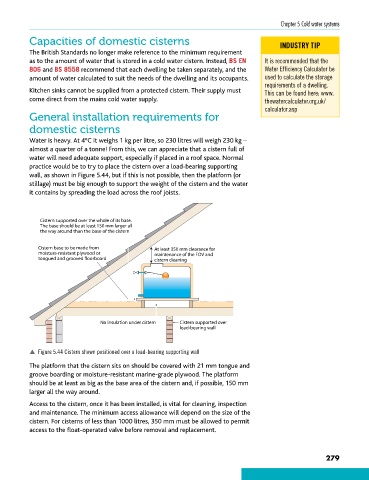
                practice would be to try to place the cistern over a load-bearing supporting
                wall, as shown in Figure 5.44, but if this is not possible, then the platform (or
                stillage) must be big enough to support the weight of the cistern and the water
                it contains by spreading the load across the roof joists.


                   Cistern supported over the whole of its base.
                   The base should be at least 150 mm larger all
                   the way around than the base of the cistern

                   Cistern base to be made from         At least 350 mm clearance for
                   moisture-resistant plywood or        maintenance of the FOV and
                   tongued and grooved floorboard       cistern cleaning


                                       No insulation under cistern  Cistern supported over
                                                                 load-bearing wall


                p  Figure 5.44 Cistern shown positioned over a load-bearing supporting wall
                The platform that the cistern sits on should be covered with 21 mm tongue and
                groove boarding or moisture-resistant marine-grade plywood. The platform
                should be at least as big as the base area of the cistern and, if possible, 150 mm
                larger all the way around.
                Access to the cistern, once it has been installed, is vital for cleaning, inspection
                and maintenance. The minimum access allowance will depend on the size of the
                cistern. For cisterns of less than 1000 litres, 350 mm must be allowed to permit
                access to the float-operated valve before removal and replacement.


                                                                                                                279


        9781510416482.indb   279                                                                                    29/03/19   8:57 PM

