


Page 293 - The City and Guilds Textbook: Plumbing Book 1 for the Level 3 Apprenticeship (9189), Level 2 Technical Certificate (8202) and Level 2 Diploma (6035)
P. 293
Chapter 5 Cold water systems


                  Service       BS 1212 part 2                 Neoprene rubber sealing
                   valve        float-operated valve           grommet around vent pipe
                                                                  Screened vent
                                                                  50 mm float-valve
                                                                  connection
                                                                  25 mm distance between
                              Water level                         FOV and overflow
                                                                  25 mm distance between
                                                                  overflow and water level
                                                              Screened overflow/warning
                                                              pipe clip below the water level
                           Cold feed to hot water storage cylinder
                               Cold distribution pipe               25 mm
                                                                    25 mm
                                      Preferred cold distribution pipe connection

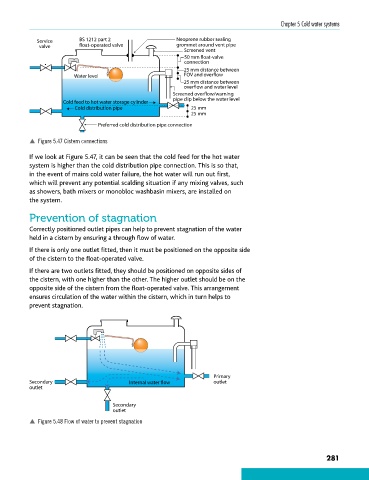
                p  Figure 5.47 Cistern connections

                If we look at Figure 5.47, it can be seen that the cold feed for the hot water
                system is higher than the cold distribution pipe connection. This is so that,
                in the event of mains cold water failure, the hot water will run out first,
                which will prevent any potential scalding situation if any mixing valves, such
                as showers, bath mixers or monobloc washbasin mixers, are installed on
                the system.

                Prevention of stagnation

                Correctly positioned outlet pipes can help to prevent stagnation of the water
                held in a cistern by ensuring a through flow of water.
                If there is only one outlet fitted, then it must be positioned on the opposite side
                of the cistern to the float-operated valve.
                If there are two outlets fitted, they should be positioned on opposite sides of
                the cistern, with one higher than the other. The higher outlet should be on the
                opposite side of the cistern from the float-operated valve. This arrangement
                ensures circulation of the water within the cistern, which in turn helps to
                prevent stagnation.


                                                                            Primary
                Secondary                       Internal water flow         outlet
                outlet


                                           Secondary
                                           outlet
                p  Figure 5.48 Flow of water to prevent stagnation


                                                                                                                281


        9781510416482.indb   281                                                                                    29/03/19   8:57 PM

