


Page 297 - The City and Guilds Textbook: Plumbing Book 1 for the Level 3 Apprenticeship (9189), Level 2 Technical Certificate (8202) and Level 2 Diploma (6035)
P. 297
Chapter 5 Cold water systems


                Air gap 2     inlet diameter      Not less than 25 mm
                                                     Not less than 25 mm
                   Service                                Overflow
                   valve
                                                           pipe


                    Shut off
                    level
                                                                    Warning alarm
                                                              Alarm sounds when the water is
                                                              25 mm from the invert of the
                                                              overflow pipe
                Cistern capacity greater than 5000 L
                Type 'AG' and 'AF' air gaps
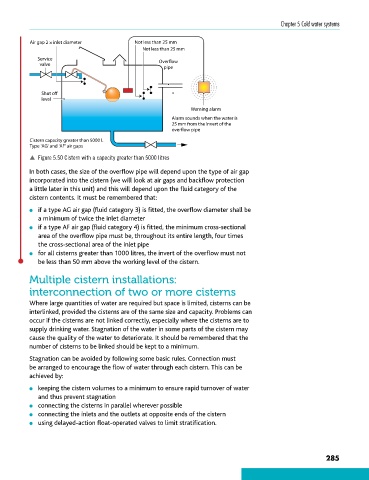
                p  Figure 5.50 Cistern with a capacity greater than 5000 litres

                In both cases, the size of the overflow pipe will depend upon the type of air gap
                incorporated into the cistern (we will look at air gaps and backflow protection
                a little later in this unit) and this will depend upon the fluid category of the
                cistern contents. It must be remembered that:

                ●  if a type AG air gap (fluid category 3) is fitted, the overflow diameter shall be
                   a minimum of twice the inlet diameter
                ●  if a type AF air gap (fluid category 4) is fitted, the minimum cross-sectional
                   area of the overflow pipe must be, throughout its entire length, four times
                   the cross-sectional area of the inlet pipe
                ●  for all cisterns greater than 1000 litres, the invert of the overflow must not
                   be less than 50 mm above the working level of the cistern.
                Multiple cistern installations:

                interconnection of two or more cisterns

                Where large quantities of water are required but space is limited, cisterns can be
                interlinked, provided the cisterns are of the same size and capacity. Problems can
                occur if the cisterns are not linked correctly, especially where the cisterns are to
                supply drinking water. Stagnation of the water in some parts of the cistern may
                cause the quality of the water to deteriorate. It should be remembered that the
                number of cisterns to be linked should be kept to a minimum.
                Stagnation can be avoided by following some basic rules. Connection must
                be arranged to encourage the flow of water through each cistern. This can be
                achieved by:

                ●  keeping the cistern volumes to a minimum to ensure rapid turnover of water
                   and thus prevent stagnation
                ●  connecting the cisterns in parallel wherever possible
                ●  connecting the inlets and the outlets at opposite ends of the cistern
                ●  using delayed-action float-operated valves to limit stratification.


                                                                                                                285


        9781510416482.indb   285                                                                                    29/03/19   8:58 PM

