


Page 299 - The City and Guilds Textbook: Plumbing Book 1 for the Level 3 Apprenticeship (9189), Level 2 Technical Certificate (8202) and Level 2 Diploma (6035)
P. 299
Chapter 5 Cold water systems

                should be fitted onto the same cistern as the float-operated valve. Both cisterns
                must be of the same size and capacity.                                           INDUSTRY TIP

                When connecting two or more cisterns, care should be taken to ensure that the   A free copy of the Water
                water movement is regular and even across all cisterns. In this situation, it is a   Supply (Water Fittings)
                good idea to install float-operated valves on all cisterns with appropriate service   Regulations 1999 can
                valves, as detailed in the Defra guidance to the Water Supply (Water Fittings)   be downloaded from the
                Regulations 1999:                                                           relevant government pages
                   Service valves should be fitted as close as is reasonably practical to    at: www.legislation.gov.uk/
                   float-operated valves.                                                   uksi/1999/1148/contents/
                                                                                            made
                Wherever a float-operated valve is fitted, then an overflow/warning pipe must
                accompany it. These should terminate in a conspicuous, visible position outside
                the building. On no account should they be coupled together.
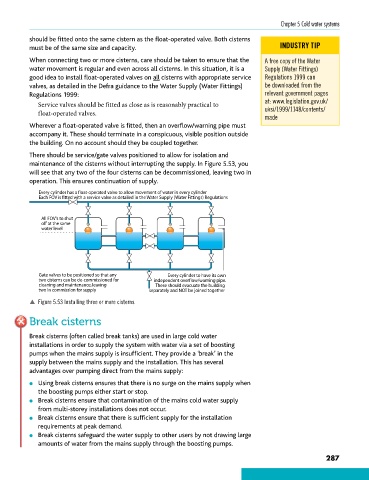
                There should be service/gate valves positioned to allow for isolation and
                maintenance of the cisterns without interrupting the supply. In Figure 5.53, you
                will see that any two of the four cisterns can be decommissioned, leaving two in
                operation. This ensures continuation of supply.

                   Every cylinder has a float-operated valve to allow movement of water in every cylinder
                   Each FOV is fitted with a service valve as detailed in the Water Supply (Water Fittings) Regulations


                    All FOV's to shut
                    off at the same
                    water level


                   Gate valves to be positioned so that any  Every cylinder to have its own
                   two cisterns can be de-commissioned for  independent overflow/warning pipe.
                   cleaning and maintenance, leaving     These should evacuate the building
                   two in commission for supply        separately and NOT be joined together

                p  Figure 5.53 Installing three or more cisterns

                Break cisterns

                Break cisterns (often called break tanks) are used in large cold water
                installations in order to supply the system with water via a set of boosting
                pumps when the mains supply is insufficient. They provide a ‘break’ in the
                supply between the mains supply and the installation. This has several
                advantages over pumping direct from the mains supply:
                ●  Using break cisterns ensures that there is no surge on the mains supply when
                   the boosting pumps either start or stop.
                ●  Break cisterns ensure that contamination of the mains cold water supply
                   from multi-storey installations does not occur.
                ●  Break cisterns ensure that there is sufficient supply for the installation
                   requirements at peak demand.
                ●  Break cisterns safeguard the water supply to other users by not drawing large
                   amounts of water from the mains supply through the boosting pumps.

                                                                                                                287


        9781510416482.indb   287                                                                                    29/03/19   8:58 PM

