


Page 35 - The City and Guilds Textbook: Plumbing Book 1 for the Level 3 Apprenticeship (9189), Level 2 Technical Certificate (8202) and Level 2 Diploma (6035)
P. 35
Chapter 1 Health and safety practices and systems

                ●  arrange to measure the level of lead in your body; this is done by a simple
                   blood test administered by a doctor at your place of work; you must be told
                   the results of your tests.
                There are ways you can help yourself too, which include the following.

                ●  Make sure you have all the information and training you need to work safely
                   with lead, including knowing what to do in an emergency such as the sudden
                   uncontrolled release of lead dust or fume into the atmosphere.
                ●  Use all the equipment provided by your employer and follow its instructions
                   for use.
                ●  Follow good work practices, keeping your immediate work area as clean and   KEY TERMS
                   tidy as possible and taking care not to take home any PPE such as overalls or   Wetting: the process of
                   protective footwear.                                                    using a flux and solder to
                ●  Wear any necessary PPE clothing and respiratory protection.             join copper components
                ●  Report any damaged or defective equipment to your employer.             is often referred to in the
                ●  Eat and drink only in designated areas that are free from lead contamination.  plumbing trade as wetting.
                ●  Practise a high standard of personal hygiene, washing your hands, face and   Rosin: a natural solid,
                   nails regularly and showering before leaving the site when necessary.   resin-type material obtained
                ●  Do not miss medical appointments with the doctor at your place of work.  from pine trees, which,
                                                                                           when heated, forms acidic
                Working with fluxes                                                        particles that can irritate the
                                                                                           breathing. This could lead
                Flux is a paste compound that helps solder to adhere to copper tubes and   to occupational asthma.
                copper-based fittings. The term we use for this process is wetting. There are two   Zinc chloride: a corrosive
                basic types of flux used today in the plumbing industry:                   substance that can cause
                                                                                           skin irritation, burns and eye
                1  Traditional fluxes: these grease-based fluxes often contain a chemical   damage if it gets in the eye.
                   called rosin (also known as colophony) or zinc chloride. Caution should be
                   exercised when using this kind of flux. It is recommended that you check
                   COSHH data sheets for further information regarding these products.
                2  Self-cleaning fluxes: this type of flux is also known as ‘active’ flux because
                   of its aggressive nature. Most are based on zinc chloride or hydrochloric acid,
                   both of which can cause burns and severe skin irritation, so careful handling
                   and use is very important. Other self-cleaning fluxes may use natural
                   enzymes as cleaning agents but these are also known to irritate the skin.

                All flux should be handled with care. Use a brush to apply the paste and always
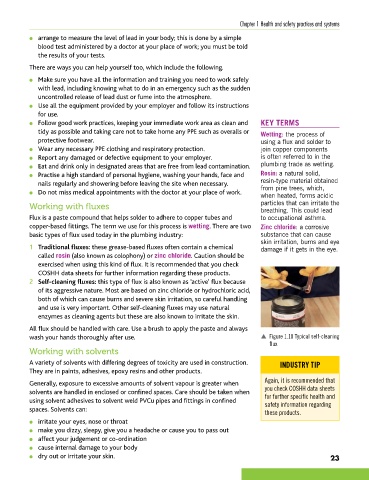
                wash your hands thoroughly after use.                                      p  Figure 1.10 Typical self-cleaning
                                                                                              flux
                Working with solvents

                A variety of solvents with differing degrees of toxicity are used in construction.   INDUSTRY TIP
                They are in paints, adhesives, epoxy resins and other products.
                Generally, exposure to excessive amounts of solvent vapour is greater when   Again, it is recommended that
                solvents are handled in enclosed or confined spaces. Care should be taken when   you check COSHH data sheets
                                                                                            for further specific health and
                using solvent adhesives to solvent weld PVCu pipes and fittings in confined   safety information regarding
                spaces. Solvents can:                                                       these products.

                ●  irritate your eyes, nose or throat
                ●  make you dizzy, sleepy, give you a headache or cause you to pass out
                ●  affect your judgement or co-ordination
                ●  cause internal damage to your body
                ●  dry out or irritate your skin.                                                                23


        9781510416482.indb   23                                                                                     29/03/19   8:49 PM

