


Page 331 - The City and Guilds Textbook: Plumbing Book 1 for the Level 3 Apprenticeship (9189), Level 2 Technical Certificate (8202) and Level 2 Diploma (6035)
P. 331
Chapter 5 Cold water systems

                low-pressure hot water. For the valve to work correctly, the mains cold water
                must have a pressure of at least 1 bar and a maximum pressure of 3 bar.
                Pressures in excess of this will require a pressure reducing valve to be fitted.
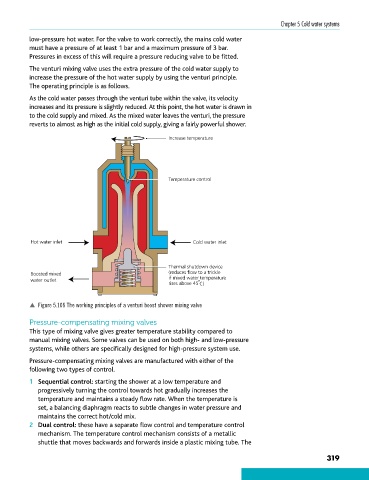
                The venturi mixing valve uses the extra pressure of the cold water supply to
                increase the pressure of the hot water supply by using the venturi principle.
                The operating principle is as follows.
                As the cold water passes through the venturi tube within the valve, its velocity
                increases and its pressure is slightly reduced. At this point, the hot water is drawn in
                to the cold supply and mixed. As the mixed water leaves the venturi, the pressure
                reverts to almost as high as the initial cold supply, giving a fairly powerful shower.

                                                             Increase temperature


                                                             Temperature control


                Hot water inlet                                      Cold water inlet


                                                             Thermal shutdown device
                Boosted mixed                                (reduces flow to a trickle
                water outlet                                 if mixed water temperature
                                                                      º
                                                             rises above 45 C)

                p  Figure 5.106 The working principles of a venturi boost shower mixing valve


                Pressure-compensating mixing valves
                This type of mixing valve gives greater temperature stability compared to
                manual mixing valves. Some valves can be used on both high- and low-pressure
                systems, while others are specifically designed for high-pressure system use.

                Pressure-compensating mixing valves are manufactured with either of the
                following two types of control.

                1  Sequential control: starting the shower at a low temperature and
                   progressively turning the control towards hot gradually increases the
                   temperature and maintains a steady flow rate. When the temperature is
                   set, a balancing diaphragm reacts to subtle changes in water pressure and
                   maintains the correct hot/cold mix.
                2  Dual control: these have a separate flow control and temperature control
                   mechanism. The temperature control mechanism consists of a metallic
                   shuttle that moves backwards and forwards inside a plastic mixing tube. The

                                                                                                                319


        9781510416482.indb   319                                                                                    29/03/19   8:59 PM

